
That folding solar panel strapped to your pack is one of the most practical pieces of off-grid gear you own. It weighs five pounds instead of twenty. It packs flat in a hatchback. You can set it up in thirty seconds and tear it down in fifteen. But that convenience comes from a design that's engineered to wear out faster than the rigid panels bolted to roofs and RVs — sometimes much faster. This isn't a reason to avoid folding panels. It's a reason to understand the trade you're making, where the weak points hide, and how to slow the clock.
The short answer: folding solar panels aren't fragile against drops — they're fragile against time. UV clouds the polymer laminate and every fold fatigues the hinge, which is why manufacturers warrant them for 1-3 years of 80% output against a rigid glass panel's 25.
Rigid panels are the opposite case. Tempered 3.2 mm glass shrugs off hail, wind load, and decades of UV, but it can crack if the panel is dropped or twisted. So whether a solar panel is fragile depends on the threat: rigid glass is fragile against impact, and folding laminate is fragile against sun and flexing.
Why Folding Panels Skip Protective Glass
The difference between a foldable solar panel and a rigid rooftop panel starts with the front surface. Rigid panels use tempered glass — typically 3.2 mm thick — to protect the photovoltaic cells. Glass is heavy, rigid, and nearly impervious to UV degradation. It's why rooftop solar installations carry 25-year linear output warranties: the glass shield keeps cells stable for decades.
Folding panels replace that glass with a polymer laminate — usually ETFE (ethylene tetrafluoroethylene) or, in budget models, PET (polyethylene terephthalate). The weight savings are dramatic: a 100W rigid panel weighs 15–20 lbs, while a lightweight 100W folding panel like the Jackery SolarSaga 100W Air (no recently verified in-stock offer) weighs a fraction of that. But polymer degrades under the same UV exposure and thermal cycling that glass shrugs off.
ETFE holds up better than PET — it's more UV-stable and resists clouding longer — but both materials slowly haze, yellow, and lose transparency over hundreds of hours in direct sun. As the laminate clouds, less light reaches the cells, and output drops. This degradation is well-documented in manufacturer warranties: folding panels typically warrant 80% output retention for one to three years. Rigid glass panels warrant the same 80% threshold at twenty-five years. That warranty gap is the durability claim, stated by the manufacturers themselves.
The cell construction underneath also matters — monocrystalline cells tolerate heat better than polycrystalline — but the laminate is the first line of defense, and it's where folding panels give ground.
Hinges and Seams: Stress Concentrations by Design
Every fold line in a portable solar panel is a point of accelerated wear. The hinge isn't just a convenience feature — it's a stress concentration that bends the laminate, flexes the backing, and strains the cells near the crease with every setup and teardown.
Micro-cracks form in photovoltaic cells near hinge points after repeated flexing. These cracks don't immediately kill output, but they create high-resistance paths that heat up under load, accelerating further degradation. In bifacial models like the Anker SOLIX PS200 Bifacial (last checked $499.99 · checked Oct 19, 2026 · see on Amazon), both the front and rear laminates flex, doubling the surface area exposed to crease fatigue.
Seams are the second vulnerability. Folding panels bond laminate layers with adhesive, and those bonds are only as durable as the weakest seam. Water intrusion at seams — even in IP67-rated enclosures — can corrode cell interconnects and junction box contacts. The IP rating measures resistance to temporary immersion, not the long-term moisture wicking that happens when you fold a damp panel and store it in a stuff sack.
Cable and connector strain concentrates at the junction box, which is typically mounted near a hinge. Every time you fold the panel, the cable bends; every time you drag the panel by its cable (don't), you stress the solder joints inside the box.
Care Habits That Extend Foldable Solar Panel Lifespan
You can't eliminate hinge wear, but you can slow it:
- Never fold the panel wet. Let it air-dry completely before packing. Trapped moisture accelerates adhesive failure and corrosion.
- Don't crease beyond the designed fold. The hinge is engineered for a specific radius; forcing a tighter fold overstresses the laminate and cells.
- Store flat when possible. If you have garage or vehicle space, store the panel unfolded or loosely rolled. Prolonged storage in the folded position can set permanent creases.
- Secure the kickstand in wind. A flapping panel in 20 mph wind flexes the hinge hundreds of times per hour. Stake it, weight it, or angle it into the wind.
- Inspect seams and connectors quarterly. Look for delamination, moisture inside the laminate, and cable strain at the junction box. Catching a failing seam early can prevent a total loss.
When Folding Wins (and When It Doesn't)
The honest durability split comes down to use case, not brand or wattage.
Folding panels win for:
- Trip-based use: Weekend camping, overlanding, emergency kits. If the panel spends most of its life in storage and sees 20–40 days of sun per year, laminate degradation stays ahead of your replacement cycle.
- Mobility and pairing with portable power stations: Every product in our comparison folds because portability is the priority. An Anker SOLIX PS200 Bifacial (last checked $499.99 · checked Oct 19, 2026 · see on Amazon) paired with a 2000 Wh power station recharges fast, packs in the same vehicle, and sets up in minutes.
- Weight-constrained scenarios: Backpacking, kayak camping, motorcycle travel. The five-to-one weight advantage over rigid panels is non-negotiable.
Rigid panels win for:
- Permanent or semi-permanent mounts: Roof racks, RV installations, base camp setups you'll use for years. If the panel stays deployed for months at a time, glass protection pays for itself in longevity.
- High-UV or high-temperature environments: Desert, high altitude, tropical sun. Glass resists UV degradation and handles thermal cycling better than any polymer.
- When you need a 10+ year service life: If you're building a long-term off-grid setup and won't replace panels every few seasons, rigid is the only choice that pencils out.
Suitcase-style panels split the difference. Models like the Renogy 400W Portable Solar Suitcase (last checked $495.99 · checked Oct 11, 2026 · see on Amazon) use tempered glass over the cells but fold at a center hinge for transport. You get glass-level UV protection and longer output retention, but you trade weight (typically 30–40 lbs for a 400W suitcase) and hinge durability. The hinge still fails eventually, but the cells underneath last longer.
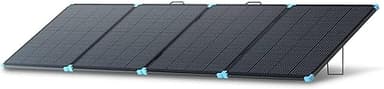
Folding Solar Panels Compared: What to Check for Durability
| Spec | Jackery SolarSaga 100W Air | Bluetti PV200 Solar Panel | Renogy 400W Portable Solar Suitcase | Anker SOLIX PS200 Bifacial Solar Panel |
|---|---|---|---|---|
| Rated Power | 100 W | 200 W | 400 W | 200 W |
| Efficiency | 23 % | — | 23 % | — |
| Foldable | Yes | Yes | Yes | Yes |
When comparing portable solar panel durability, four specs predict lifespan better than wattage or efficiency:
Laminate material: ETFE outlasts PET by a wide margin. Manufacturer specs rarely list this explicitly, but warranty length is a proxy — panels with three-year warranties usually use ETFE; one-year warranties often indicate PET. The Jackery SolarSaga lineup and Anker SOLIX models use ETFE across the board.
Warranty length: A manufacturer's warranty is their durability claim. One year says "this is disposable convenience." Three years says "we expect this to hold up under regular use." Twenty-five years (rigid panels only) says "the cells will outlive your truck."
IP rating: IP65 means dust-tight and resistant to water jets; IP67 adds temporary immersion resistance; IP68 tolerates sustained submersion. Higher ratings mean better seam sealing, but no IP rating prevents moisture intrusion if you fold a wet panel.
Hinge construction: Look for reinforced fabric hinges or metal-pinned joints, not just stitched seams. Suitcase-style panels with latching hinges (like the Renogy 400W) concentrate stress on hardware instead of laminate, which is easier to replace if it fails.
Efficiency (21–23% in modern monocrystalline panels) affects output, not durability. A 23% efficient panel won't last longer than a 21% panel — it just produces more power while it lasts.
How long do folding solar panels last?
Most folding solar panels retain 80% of rated output for one to three years under regular use, based on manufacturer warranties. Real-world lifespan depends on UV exposure, fold frequency, and care. Panels used 20–40 days per year and stored properly often remain functional for five-plus years, but with measurable output degradation. Rigid glass panels, by comparison, are warrantied for twenty-five years to the same 80% threshold.
What's the difference between ETFE and PET coating on folding solar panels?
ETFE (ethylene tetrafluoroethylene) is a fluoropolymer with superior UV resistance, higher temperature tolerance, and slower clouding than PET (polyethylene terephthalate). ETFE-coated panels typically carry longer warranties and maintain transparency for more sun hours. PET is lighter and cheaper but yellows and hazes faster, especially in high-UV environments. Most premium folding panels — including the Jackery and Anker models in this comparison — use ETFE.
Can I leave a folding solar panel outside permanently?
Not recommended. Folding panels are engineered for trip-based use, not continuous outdoor exposure. The polymer laminate degrades faster under 24/7 UV and thermal cycling than glass-protected rigid panels. Wind flexes the hinges, moisture intrudes at seams, and output fades within months. If you need a permanent install, choose a rigid panel. If you must leave a folding panel deployed for weeks, secure it flat, inspect seams weekly, and bring it in during storms.
Do folding solar panels lose output over time?
Yes. All solar panels degrade, but folding panels degrade faster due to laminate clouding, hinge flex, and seam fatigue. Expect 1–3% annual output loss in the first few years, accelerating as the laminate hazes. A 100W panel might drop to 90–95W after two seasons of heavy use, and 80W after five. Rigid glass panels degrade at 0.5% per year or less. Laminate quality (ETFE vs PET) and care habits (fold frequency, storage conditions) strongly influence the rate.
Are suitcase-style solar panels more durable than folding fabric panels?
Yes, in one key way: suitcase panels use tempered glass over the cells, which resists UV degradation far better than polymer laminates. The glass protects cells for decades, not years. But the hinge remains a vulnerability — it's just a different failure mode. Fabric-hinge folding panels fail at the laminate and seams; suitcase panels fail at the latch and metal hinge. Suitcase panels like the Renogy 400W offer longer cell life but weigh three to six times more than fabric-folding equivalents.
Are solar panels fragile?
Rigid glass panels are not — tempered 3.2 mm glass survives hail, wind load, and decades of UV, which is why rooftop panels carry 25-year warranties. Folding panels are tougher against drops and impacts (no glass to shatter) but more fragile against the slow stresses: UV clouding of the polymer laminate, flex fatigue at the hinges, and moisture wicking into seams. So the honest answer is that fragility depends on the threat. Drop a rigid panel and you may crack it; leave a folding panel deployed in sun and wind for a season and you'll fade it. Neither failure is sudden — output degrades before the panel dies.
Do folding solar panels break if you drop them?
Usually not from the drop itself. A folding panel has no glass to shatter, so a fall onto dirt or a truck bed typically leaves it working. The damage shows up elsewhere: a corner impact can crack cells under the laminate, a hard landing on an open hinge can tear the seam, and a snagged cable can pull on the junction box. The tell is a drop in output rather than a visible break, so measure a panel's wattage after a fall instead of trusting its appearance. Rigid glass panels are the reverse case — a drop can crack the glass outright.
How do you protect a folding solar panel?
Fold it only at the designed hinges, dry it before storing, keep it in its case or a padded sleeve, and bring it in during wind and storms. Deploy it on a stand or a flat surface rather than draped over rocks, which flexes the laminate between hinges. Don't drag or lift it by the cable. On a long trip, wipe dust off the surface and inspect the seams and junction box for lifted edges. Since UV exposure is the main ager, pack the panel away when it isn't charging rather than leaving it in the sun all day.
What happens if a solar panel gets bent?
Bending cracks the photovoltaic cells inside, even when the surface looks fine. Micro-cracks create high-resistance paths that heat up under load and accelerate output loss — the panel usually keeps working, just at reduced and declining wattage. Folding panels are engineered to bend only at their designed hinge radius; creasing one anywhere else, or forcing a tighter fold, damages cells the same way bending a rigid panel does. There's no practical repair: once cells are cracked, output loss is permanent. If a bent panel still meets your charging needs, keep using it — but measure its output so you know what you actually have.
Is the weight saving of folding panels worth the lifespan cost?
Depends on your use case. For trip-based camping, overlanding, or emergency kits where the panel sees limited annual sun exposure and portability is critical, the weight saving is absolutely worth it. A five-pound panel you'll actually carry beats a twenty-pound panel you leave home. For permanent installs, base camps, or setups you'll depend on for years, the lifespan cost is too high — rigid panels pay back the weight penalty in longevity. Suitcase panels split the difference if you need both portability and multi-year durability, but accept the weight.
The Bottom Line: Know the Trade, Not the Marketing
Folding solar panels aren't fragile — they're optimized for a different priority than longevity. Every manufacturer in this space makes the same trade: cut weight and pack size by replacing glass with polymer, accept faster degradation, and warranty accordingly. That's not deception; it's engineering.
If you camp twenty weekends a year, chase overlanding routes, or keep a go-bag in your truck, a folding panel will outlast your interest in the hobby. The Jackery SolarSaga 100W Air (no recently verified in-stock offer) is light enough for solo trips and efficient enough for sub-1000 Wh power stations. The Anker SOLIX PS200 Bifacial (last checked $499.99 · checked Oct 19, 2026 · see on Amazon) doubles that output without doubling pack size. For high-output field charging, the Renogy 400W suitcase (last checked $495.99 · checked Oct 11, 2026 · see on Amazon) adds glass protection at the cost of weight and hinge complexity.
If you're building a long-term off-grid power system or installing panels you won't touch for years, don't fold. Go rigid, pay the weight, and collect the warranty.
The durability cost of folding is real. The convenience gain is also real. Buy for the use case, care for the hinges, and replace when output fades — not when the marketing says you should.