
Three cell technologies dominate portable solar: monocrystalline, polycrystalline, and thin-film. Each trades efficiency, weight, cost, and durability differently. Pick wrong and you're either hauling dead weight or waiting three extra hours for a full charge. The right panel type depends on your use case — space constraints, budget, or how often you're moving the panel. Here's how to match the technology to the job.
Monocrystalline: Maximum Efficiency, Minimum Space
Monocrystalline panels use single-crystal silicon cells, typically delivering 20–23% conversion efficiency in modern portable panels. That's the highest energy output per square foot of any commercially available solar technology.
The manufacturing process — slicing wafers from a single silicon ingot — costs more, but produces cells with uniform crystal structure. That uniformity improves electron flow and boosts low-light performance. When clouds roll in or the sun sits low on the horizon, monocrystalline panels keep generating power while other types taper off.
Nearly every premium portable panel sold today uses monocrystalline cells. As production scaled and prices dropped over the past decade, mono became the default for weight-sensitive applications. If you're carrying the panel on your back or packing it into a vehicle, the space savings matter more than the marginal cost difference.
All four panels in our comparison lineup use monocrystalline cells — the efficiency advantage is non-negotiable when you're optimizing for portability.
Polycrystalline: Budget Option With Declining Relevance
Polycrystalline panels form cells from melted and poured silicon fragments, creating a multi-crystal structure with visible grain boundaries. The blue-flecked appearance is the giveaway.
Efficiency typically lands between 15–17%, meaning you need roughly 25% more surface area to match monocrystalline output. That's fine for rooftop installs where space is cheap. It's a poor trade for portable panels where every square inch adds bulk and weight.
The manufacturing cost advantage that once made poly panels attractive has narrowed. As monocrystalline production scaled globally, the price gap shrank to the point where most portable solar manufacturers abandoned polycrystalline entirely. You'll still find poly panels in budget home kits and older fixed installations, but the portable market has moved on.
If you see a polycrystalline portable panel today, it's usually old stock or a budget product cutting corners. The space penalty isn't worth the savings.
Thin-Film: Flexibility at the Cost of Performance
Thin-film panels deposit photovoltaic material onto flexible substrates like plastic or metal foil. The result bends, weighs a fraction of rigid panels, and conforms to curved surfaces — RV roofs, boat decks, backpack shells.
Efficiency drops to 10–13%, less than half that of premium monocrystalline panels. You'll need double the surface area for equivalent output, assuming you have the space. Lifespan is the bigger concern: laminate construction degrades faster than tempered glass, especially with repeated flexing and UV exposure. Expect 3–5 years of reliable output versus 10–15 for rigid mono panels.
Thin-film makes sense when rigidity is impossible — permanent curved-roof installs or ultralight backpacking where every ounce matters and you accept the performance trade. For everything else, modern foldable monocrystalline panels pack small enough that the flexibility advantage disappears.
We cover durability differences in depth in our folding solar panel durability guide, including how frame construction and hinge design affect lifespan across panel types.
Which Type Should You Actually Buy?
Choose monocrystalline for portable setups and roofs with limited space. Consider thin-film when the mounting surface requires flexibility; consider polycrystalline mainly when matching an existing array. Use the setup constraints below to narrow the choice.
Backpacking or weight-critical travel: Monocrystalline foldable panels only. You need maximum watts per pound. The Jackery SolarSaga 100W Air (no recently verified in-stock offer) hits 23% efficiency in a lightweight bifacial design — that's about as good as portable solar gets in 2026.
Car camping or power station pairing: Still monocrystalline, but optimize for output over pack size. A 200W panel charges mid-capacity power stations in 3–4 hours of good sun. The space savings of high-efficiency cells let you pack more watts into the same footprint.
Van or RV roof (permanent install): Monocrystalline rigid panels if space is limited. Thin-film only if you're mounting on a curved fiberglass roof where rigid panels won't sit flush. Accept the efficiency penalty — you're not moving the panel daily, so durability and output per square foot matter more than weight.
Home backup (ground deploy or temporary setup): Monocrystalline foldable panels with kickstands. You'll move them occasionally to chase the sun or store them between uses. Portability still matters, even if you're not hiking with them.
Polycrystalline makes the list only if you're expanding an existing poly array and need to match old panels. Even then, the efficiency gap complicates charge controller settings.
Our Monocrystalline Portable Picks
| Spec | Jackery SolarSaga 100W Air | Bluetti PV200 Solar Panel | Renogy 400W Portable Solar Suitcase | Anker SOLIX PS200 Bifacial Solar Panel |
|---|---|---|---|---|
| Rated Power | 100 W | 200 W | 400 W | 200 W |
| Efficiency | 23 % | — | 23 % | — |
| Foldable | Yes | Yes | Yes | Yes |
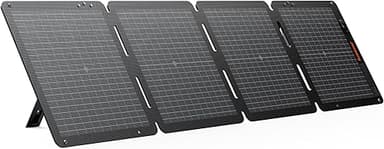
The 100W Air balances output and pack weight for solo or ultralight setups. Bifacial cells capture reflected light from the ground, boosting real-world output by 5–10% on reflective surfaces. IP65 weather resistance handles rain and dust. At 23% efficiency, it's competitive with the best portable panels in any category.
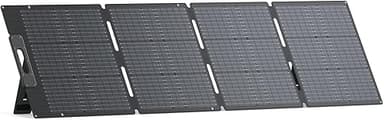
Anker's 200W bifacial doubles the 100W Air's output in a foldable package with an adjustable stand. The dual-sided cells harvest reflected light off snow, sand, or pale ground — a genuine real-world gain over single-sided panels in the right conditions. This is the pick for fast power station charging when you have room in the vehicle.
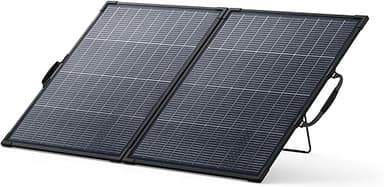
The Bluetti PV200 is the single-sided 200W value option — dependable output with an integrated kickstand and carry handle, purpose-built for pairing with Bluetti stations but compatible with other brands via standard connectors.
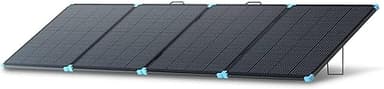
The Renogy 400W suitcase is the high-output outlier: two hinged glass-protected panels at 23% efficiency, built for quick deploy-and-stow. It's the pick when one deployable unit needs to do the work of two 200W foldables — from a dedicated solar specialist rather than a power-station brand.
FAQ
Are all portable solar panels monocrystalline now?
Nearly all premium and mid-tier portable panels sold in 2026 use monocrystalline cells. The efficiency advantage (20–23% vs. 15–17% for polycrystalline) became essential as manufacturers optimized for pack size and weight. You'll still find polycrystalline in budget home kits, but the portable market has standardized on mono.
Is polycrystalline ever worth buying today?
Only in two scenarios: you're expanding an existing polycrystalline array and need matching voltage characteristics, or you're installing a fixed ground mount where space is unlimited and you're buying strictly on lowest cost per watt. For portable applications, the space penalty outweighs any cost savings.
How long do thin-film solar panels last?
Expect 3–5 years of reliable output from thin-film panels, versus 10–15 years for rigid monocrystalline panels with tempered glass. Thin-film degrades faster due to laminate construction — UV exposure and repeated flexing break down the photovoltaic layer and encapsulation. Some manufacturers rate thin-film for up to 10 years, but real-world performance typically drops below 80% of rated output after 5 years.
Does cell type affect cloudy-day output?
Yes. Monocrystalline panels maintain higher output in diffuse light and low-sun conditions due to uniform crystal structure — electrons flow more efficiently even when photon input drops. Polycrystalline and thin-film both see steeper performance drops in overcast weather. Expect monocrystalline to deliver 10–15% more power than poly in identical cloudy conditions.
What efficiency number should I look for in a portable panel?
Target 20% or higher for monocrystalline portable panels in 2026. Budget panels may land around 18%, while premium models hit 23%. Anything below 18% is either old technology or compromised manufacturing. Efficiency directly translates to watts per square foot — higher numbers mean smaller, lighter panels for the same output.
Can I mix monocrystalline and polycrystalline panels?
Not recommended. The two cell types have different voltage and current characteristics, which complicates charge controller behavior and can cause the higher-performing mono panels to drag down to poly's output level. If you're expanding an array, match the existing cell type. If you're starting fresh, go all monocrystalline.
Final Recommendation
Monocrystalline panels won the portable solar race. The efficiency gap is too large to justify polycrystalline unless you're stuck matching legacy equipment. Thin-film serves a narrow niche — curved permanent mounts or ultralight backpacking where you accept the performance penalty.
For camping, van life, and emergency backup, buy monocrystalline foldable panels in the 100–200W range depending on your power station capacity. The Jackery SolarSaga 100W Air (no recently verified in-stock offer) is the efficiency benchmark at 23%, while the Anker SOLIX PS200 Bifacial (last checked $499.99 · checked Oct 19, 2026 · see on Amazon) doubles output for faster charging. Both use bifacial cells — the performance standard for portable solar in 2026.
Match the wattage to your power station's input capacity and typical daily draw. Cell type is already decided: mono is the only choice that makes sense.