

Corrected October 25, 2026: updated the F3000 output, surge, solar input, cycle life, and weight against Anker’s US specifications. Its rubric score is now 4.4/5. Recharge remains a calculated minimum on the included cable.
Also considering a 5kWh unit? The Anker SOLIX S5000 specification preview covers its manufacturer-rated 5,024Wh capacity and 120/240V output. It has no verified retailer offer here. See the S5000 vs Delta Pro 3, F3000, and Apex 300 comparison for the capacity, charging, and solar tradeoffs.
Two big home-backup stations. They overlap in mission but separate on scale.
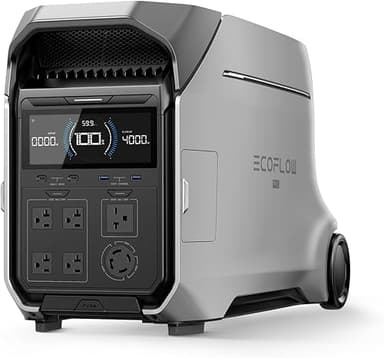
The EcoFlow goes bigger. 4,096Wh versus the Anker's 3,072Wh, 4,000W of 120/240V output for hard-wired 240V appliances, and expandability to 48kWh (double the F3000's 24kWh). If your goal is to back up an entire home or build a large off-grid bank, the Delta Pro 3 has more ceiling — and a bigger 2,600W solar input to match.
The Anker is the lighter, leaner option. At 91.5 lbs it undercuts the Delta Pro 3's 113.5 lbs by 22 pounds, with a 7,200W claimed surge for suitable 120V loads; verify outlet limits and motor-start requirements (see Surge Watts vs Running Watts). For a fridge-plus-essentials backup that you might occasionally move, 3kWh is plenty and the F3000 typically costs less.
F3000 vs Delta Pro 3: the spec sheet side by side
Every figure below is the manufacturer's rating unless marked as our arithmetic.
| Spec | Anker SOLIX F3000 | EcoFlow Delta Pro 3 | Edge |
|---|---|---|---|
| Rated capacity | 3,072Wh | 4,096Wh | EcoFlow |
| Usable capacity (× 0.85) | ~2,610Wh | ~3,480Wh | EcoFlow |
| Running watts | 3,600W | 4,000W | EcoFlow |
| Surge watts | 7,200W | 8,000W | EcoFlow |
| Output voltage | 120V | 120/240V | EcoFlow |
| Rated cycle life | 4,000 cycles | 4,000 cycles | Tie |
| Max solar input | 2,400W (1,600W + 800W inputs) | 2,600W | EcoFlow |
| Advertised UPS switchover | 20ms (35ms when a connected generator stops) | 10ms | EcoFlow |
| Expansion | To 24kWh | To 48kWh | EcoFlow |
| Weight | 91.5 lbs | 113.5 lbs | Anker |
Usable Wh = rated Wh × 0.85 (inverter loss, applied once — how we calculate runtime).
The Delta Pro 3 leads on capacity, single-unit voltage options, output, and expansion; rated cycle life is tied. The question is whether you need what it adds: 240V output, another ~870Wh usable, and a 48kWh ceiling. For many households, a 120V critical-loads panel is the whole job, and the F3000 does that job at 22 fewer pounds.
What each one actually runs
Runtime = usable Wh ÷ device watts, with device draw used as-is. Nights are rounded down to the half night.
| Load | Typical draw | F3000 (~2,610Wh) | Delta Pro 3 (~3,480Wh) |
|---|---|---|---|
| CPAP, humidifier on | 60W | ~43 hours (5 nights at 8 hrs) | ~58 hours (7 nights at 8 hrs) |
| Full-size fridge (cycling) | ~65W avg | ~40 hours | ~53 hours |
| Outage essentials (fridge, Wi-Fi, lights) | ~200W | ~13 hours | ~17 hours |
| Window AC unit | ~1,200W | ~2 hours | ~3 hours |
The Delta Pro 3 carries a third more usable energy. On a 200W essentials load, that's about four more hours: the difference between making it to morning on a long winter night and not.
Recharge: wall and solar
On AC, neither headline figure is what you get with just the in-box cable on a regular outlet. Anker advertises 78 minutes for the F3000, but that runs at 3,600W through a TT-30 cable and an EV adapter sold separately. On the 1,800W cable in the box, 3,072Wh ÷ 1,800W puts the floor near 1 hour 42 minutes (details in the review). EcoFlow rates the Delta Pro 3 at about 60 minutes. Putting 4,096Wh in an hour takes roughly 4.1kW, more than a standard 120V household circuit supplies, so plan on a 240V circuit to get near that figure.
On solar, the Delta Pro 3 accepts up to 2,600W and the F3000 up to 2,400W across two inputs. At our planning multiplier — real solar watts = rated panel watts × 0.65 — an array sized to each unit's maximum input gives:
- F3000: 3,072Wh ÷ (2,400W × 0.65) ≈ 2.0 hours of full sun
- Delta Pro 3: 4,096Wh ÷ (2,600W × 0.65) ≈ 2.4 hours of full sun
The F3000 total requires suitable arrays on its 1,600W high-PV input (11–165V, 17A max) and 800W low-PV input (11–60V, 17A max). The watts-only estimate does not verify wiring, voltage, or current compatibility. Model your own array in the solar recharge calculator.
As a UPS: 20ms vs 10ms
EcoFlow states 10ms for the Delta Pro 3, inside the 16–20ms most desktop PC power supplies can bridge. Anker states 20ms for the F3000, at the edge of that window, and 35ms when a connected generator stops. Networking gear, laptops, and CPAPs ride through either gap. For a desktop or NAS on the F3000, put a small UPS in front. Both are manufacturer claims with no stated load. The full table is in Can a Power Station Replace a UPS?.
FAQ
Can the Anker SOLIX F3000 run 240V appliances?
A single F3000 supplies 120V. Anker specifies two F3000 units plus its optional Double Voltage Hub for 240V. The Delta Pro 3 offers 120/240V from one unit. Check appliance load and connection requirements in either case.
How many nights will each run a CPAP?
At 60W for 8 hours a night, about 5 nights on the F3000 and 7 on the Delta Pro 3. Sizing by CPAP model is in our CPAP battery backup guide.
How long does the F3000 really take to recharge?
Anker's 78-minute figure needs a TT-30 cable and an EV adapter sold separately. On the 1,800W cable included in the box, the arithmetic floor is about 1 hour 42 minutes. Anker doesn't publish the in-box figure.
Which expands further?
The Delta Pro 3, to 48kWh with add-on batteries, against the F3000's 24kWh.
Who should buy which
Best for whole-home backup: EcoFlow Delta Pro 3 (no recently verified in-stock offer). 240V output, a third more usable energy, the stronger solar input, and a 10ms switchover. Don't buy it if you'll ever need to move it; at 113.5 lbs it's an installed unit.
Best for a 120V critical-loads panel: Anker SOLIX F3000 (last checked $1499.99 · checked Oct 26, 2026 · see on Amazon). 7,200W of surge for 120V well pumps and compressors, about 5 CPAP nights, and 34 fewer pounds. Don't buy it if you need 240V appliances, or you want fast wall charging without buying extra cables.
Weighing the Bluetti instead? See Delta Pro 3 vs Apex 300.