
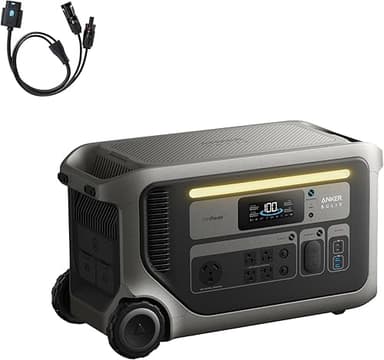
Our Review
A 3,072Wh home-backup powerhouse with massive 7,200W surge headroom and 2,400W solar input — expandable to 24kWh if you need to power a house through a multi-day outage.
Specifications
| Capacity | 3072 Wh |
|---|---|
| Continuous output | 3600 W |
| Surge output | 7200 W |
| Battery chemistry | LiFePO4 |
| Cycle life (to 80%) | 4000 cycles |
| AC recharge | ~102 min calculated minimum (included 1800W cable); actual full charge takes longer |
| Max solar input | 2400 W |
| Weight | 91.5 lbs |
Corrected October 25, 2026: Anker’s US specifications list 3,600W output, 7,200W AC surge, 2,400W solar input, 4,000 cycles, and 91.5 lb. Earlier copy understated these ratings and weight. The resulting rubric score is 4.4/5, up from 4.0; the worksheet shows the calculation. Recharge remains a calculated minimum on the included cable. Sources: Anker US specifications and Anker’s US datasheet.
The SOLIX F3000 combines 3,072Wh of capacity with 3,600W of 120V AC output and a 7,200W claimed surge. Those ratings provide headroom for suitable 120V appliances, but do not guarantee a compressor start. Check outlet current, surge duration, and your appliance’s voltage and startup requirements. A single F3000 does not supply 240V; that requires two units and the optional Double Voltage Hub.
It's expandable to 24kWh with add-on batteries, takes up to 2,400W of solar, and uses a 4,000-cycle LiFePO4 pack — solid, though it trails the Bluetti Apex 300 (last checked $1498.98 · checked Oct 19, 2026 · see on Amazon)'s 6,000-cycle rating, the highest we list.
One caveat on charging. Anker advertises a 78-minute AC recharge, but that figure runs at 3,600W — and the AC cable in the box is rated 1,800W. Reaching 3,600W requires a TT-30 cable and an EV charging adapter, both sold separately. On the included cable, 3,072Wh divided by 1,800W puts the theoretical floor near 1 hour 42 minutes, and Anker does not publish the actual in-box figure. We score the recharge you get by default. The tradeoff is obvious from the spec sheet: at 91.5 lbs it's a wheeled, two-hands appliance, not something you carry to a campsite.
Pros
- 3,072Wh runs a fridge for 24+ hours
- 7,200W claimed AC surge for suitable 120V loads
- Expandable to 24kWh for multi-day backup
- 2,400W solar input recharges fast off-grid
Cons
- 91.5 lbs — home/RV unit, not portable
- 4,000 cycles trails the Bluetti Apex 300's 6,000
- Overkill (and over-budget) for campsite use
What it actually runs
A full 3,072Wh charge yields roughly 2,600Wh usable — enough to push well past a full day on the essentials:
| Load | Typical draw | Runtime per charge |
|---|---|---|
| Full-size fridge | ~65W avg | ~40 hours (≈1.7 days) |
| Outage essentials (fridge + WiFi + lights) | ~200W | ~13 hours |
| CPAP (humidifier on) | 60W | ~43 hours (5 nights) |
| Microwave | 1,000W | ~2.5 hours total runtime |
| Furnace blower | ~300W run | ~8 hours |
Add-on batteries push this to 24kWh, turning a day of backup into most of a week.
Can the SOLIX F3000 run my whole house?
A single unit can supply suitable 120V critical loads within its outlet and total output limits. Anker specifies two F3000 units plus its optional Double Voltage Hub for 240V output. Verify transfer-switch compatibility and appliance startup requirements separately.
How long will it power a fridge during an outage?
Around 40 hours on the fridge alone, or roughly 13 hours if you're also running lights, WiFi, and phone charging — comfortably through most grid outages.
Who it's for: homeowners building outage resilience and RVers who want one unit to run everything. For portable trips, step down to the Anker SOLIX C1000 Gen 2 (last checked $699.99 · checked Oct 19, 2026 · see on Amazon).