

Updated October 22, 2026: added links to the S5000 specification preview and four-station comparison. Existing product ratings are unchanged.
Also considering a 5kWh unit? The Anker SOLIX S5000 specification preview covers its manufacturer-rated 5,024Wh capacity and 120/240V output. It has no verified retailer offer here. See the S5000 vs Delta Pro 3, F3000, and Apex 300 comparison for the capacity, charging, and solar tradeoffs.
Both are dual-voltage (120/240V) flagships built to back up a home through a transfer switch, so this is a question of capacity-and-expansion versus longevity-and-value.
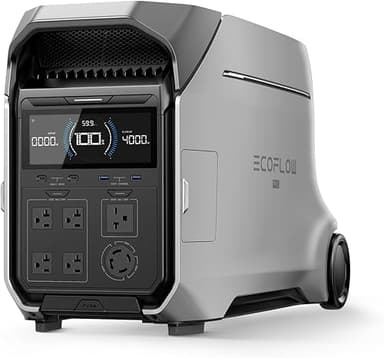
The EcoFlow scales bigger. 4,096Wh versus 2,764Wh out of the box, 4,000W output, and expandability to a massive 48kWh make the Delta Pro 3 the choice if you're protecting a whole house or planning a large off-grid system. Its 2,600W solar input is also enormous.
The Bluetti lasts longer per dollar. Its standout is a 6,000-cycle battery — 50% more than the Delta Pro 3's 4,000, and the highest in our entire lineup (why that's the value spec). With 3,840W output and 7,680W surge it still runs essentially anything; you're trading top-end capacity for a longer service life and usually a lower price.
Delta Pro 3 vs Apex 300: the spec sheet side by side
Every figure below is the manufacturer's rating unless marked as our arithmetic.
| Spec | EcoFlow Delta Pro 3 | Bluetti Apex 300 | Edge |
|---|---|---|---|
| Rated capacity | 4,096Wh | 2,764Wh | EcoFlow |
| Usable capacity (× 0.85) | ~3,480Wh | ~2,350Wh | EcoFlow |
| Running watts | 4,000W | 3,840W | EcoFlow |
| Surge watts | 8,000W | 7,680W | EcoFlow |
| Output voltage | 120/240V | 120/240V | Tie |
| Rated cycle life | 4,000 cycles | 6,000 cycles | Bluetti |
| Max solar input | 2,600W | 2,400W | EcoFlow |
| Advertised UPS switchover | 10ms | "0ms or 20ms," outlet-dependent | Bluetti (on its 0ms outlets) |
| Expansion | To 48kWh | Expandable (ceiling not stated on our spec sheet) | EcoFlow |
| Weight | 113.5 lbs | 81.6 lbs | Bluetti |
Usable Wh = rated Wh × 0.85 (inverter loss, applied once — how we calculate runtime).
What each one actually runs
Runtime = usable Wh ÷ device watts, with device draw used as-is. Nights are rounded down to the half night.
| Load | Typical draw | Delta Pro 3 (~3,480Wh) | Apex 300 (~2,350Wh) |
|---|---|---|---|
| CPAP, humidifier on | 60W | ~58 hours (7 nights at 8 hrs) | ~39 hours (4.5 nights at 8 hrs) |
| Full-size fridge (cycling) | ~65W avg | ~53 hours | ~36 hours |
| Critical-loads panel | ~250W | ~14 hours | ~9 hours |
| Window AC unit | ~1,200W | ~3 hours | ~2 hours |
The Delta Pro 3 carries about 48% more usable energy. On a 250W critical-loads panel, the Delta Pro 3 covers a 12-hour night with about 2 hours to spare, while the Apex 300 runs out after about 9 hours.
Recharge: wall and solar
On AC, both advertised figures come with conditions. EcoFlow rates the Delta Pro 3 at about 60 minutes to full. Putting 4,096Wh in an hour takes roughly 4.1kW, more than a standard 120V household circuit can supply (about 1,800W), so plan on a 240V circuit to get near that figure. Bluetti advertises a 65-minute full charge for the Apex 300, but that needs its TurboBoost port and a cable sold separately. The AC cable in the box is rated 1,800W, which puts the floor for a full charge near 1 hour 32 minutes (details in the review).
On solar, the Apex 300 refills sooner despite the lower input rating, because its battery is smaller. At our planning multiplier — real solar watts = rated panel watts × 0.65 — an array sized to each unit's maximum input gives:
- Delta Pro 3: 4,096Wh ÷ (2,600W × 0.65) ≈ 2.4 hours of full sun
- Apex 300: 2,764Wh ÷ (2,400W × 0.65) ≈ 1.8 hours of full sun
Either is a rooftop-scale array, not a camping kit. Model your own in the solar recharge calculator.
As a UPS: 0ms vs 10ms
These are the two fastest switchover figures we track. EcoFlow states 10ms for the Delta Pro 3, which is inside the 16–20ms most desktop PC power supplies can bridge. Bluetti states "0ms or 20ms" for the Apex 300 and doesn't say on the product page which outlets get which. A true 0ms transfer requires the load to stay on the inverter the whole time, so treat the 0ms figure as applying only to the outlets the manual specifies. Plug the desktop or NAS into one of those. Both figures are manufacturer claims with no stated load; test with your own hardware before trusting either with unsaved work. The full table is in Can a Power Station Replace a UPS?.
FAQ
Is the EcoFlow Delta Pro 3 or the Bluetti Apex 300 better for home backup?
For a whole-home setup through a transfer switch, the Delta Pro 3. It has 48% more usable energy out of the box and a stated 48kWh expansion path. For the longest service life, the Apex 300. Its 6,000-cycle rating is the longest we track, and it weighs 32 lbs less.
Does the Bluetti Apex 300 really have a 0ms UPS?
Bluetti's own wording is "0ms or 20ms," depending on the outlet. It doesn't specify which outlets on the product page. Use the outlet the manual identifies for 0ms, and test with your equipment before relying on it.
How many nights will each run a CPAP?
At 60W for 8 hours a night, about 7 nights on the Delta Pro 3 and 4.5 on the Apex 300. Sizing by CPAP model is in our CPAP battery backup guide.
Can both run 240V appliances?
Yes. Both have true 120/240V dual-voltage output, so both can run a 240V well pump or hard-wired circuits through a transfer switch.
Who should buy which
Best for whole-home backup: EcoFlow Delta Pro 3 (no recently verified in-stock offer). The most capacity per unit we track, a stated 48kWh expansion path, and a 10ms switchover. Don't buy it if you'll ever need to move it; at 113.5 lbs it's an installed unit.
Best for longevity and sensitive electronics: Bluetti Apex 300 (last checked $1498.98 · checked Oct 19, 2026 · see on Amazon). A 6,000-cycle battery, a 0ms switchover on some outlets, and faster solar refills. Don't buy it if you need more than about 2.3kWh usable without adding batteries.