
Solar Panels
Portable solar panels for recharging power stations
A portable solar panel is what turns a power station from a battery you have to refill into something that can sustain itself. Ratings are measured under laboratory conditions you will not reproduce outdoors, so the useful comparison is between panels, not between a panel and its own spec sheet.
How to choose
Rated watts are a ceiling, not a yield
Panel ratings assume 1000W/m² irradiance at 25°C with the cells square to the sun. Outdoors, cell temperature above 25°C alone costs a few percent, and angle costs more than most people expect — a panel flat on the ground in the morning may produce a third of its rating. Plan on 70–80% of rated output at solar noon and taper from there. Why solar charges slower than advertised has the full picture.
Confirm the connector and voltage window
Compatibility is the most common disappointment. The plug matters, but the voltage window matters more: a panel whose open-circuit voltage falls below the station's MPPT range will trickle, and one above its ceiling will not charge at all. Check the panel's voltage against the station's stated input range, not just the barrel or XT60 fitting.
Folding, suitcase, or bifacial
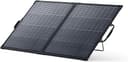
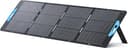
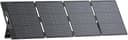
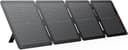
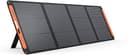
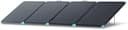
Folding panels pack smallest and suit camping. Suitcase panels add a built-in stand, which is worth more than it sounds — a good angle beats extra wattage on most days. Bifacial panels collect reflected light off the rear face and gain most over snow, sand, or light concrete, and close to nothing over grass or dirt.
Size the array to the station
More panel is not always usable: every station caps its solar input, and wattage above that ceiling is simply discarded. Work out the recharge you need, add the derating above, then check the total against the station's input limit before adding panels. Our power station guide lists input ceilings alongside capacity.