
The blower that keeps your airway open all night sips power — the heated plate that warms your humidifier water gulps it. If you woke at 2 a.m. to a dead battery and a dark machine, the humidifier is almost certainly why. The CPAP motor itself runs efficiently on 30-40 watts. Add heated humidification and a heated tube, and you've more than doubled that draw. Resistive heating is the same physics as a space heater: comfort features are heat features, and heat is where watt-hours die.
Where the Watts Go
Manufacturer documentation shows typical draw ranges:
- CPAP blower alone: 30-40W average (varies with pressure setting and mask leakage)
- Heated humidifier: adds 10-30W depending on heat level — often doubling total system draw
- Heated tube: adds another 5-15W on top
Those are planning bands. The manufacturer's own typical and peak figures for the ResMed AirSense 10 and 11 and AirMini are collected in how many watts does a CPAP use?, and the CPAP runtime calculator turns any of them into nights per charge with the humidifier on or off.
A baseline CPAP setup with no heated components averages around 30-40W. Enable the humidifier and tube, and you're drawing 60-80W or more — especially on cold, dry nights when the thermostat works hardest to maintain set temperature.
Resistive heating elements work like miniature space heaters. They convert electrical energy directly into heat with near-perfect efficiency, which sounds good until you realize every watt spent warming water is a watt your battery doesn't get to use for therapy time. Cold ambient temperatures force the heating plate to work continuously, and low humidity makes evaporation faster, demanding even more heat input to maintain the reservoir temperature.
Check your CPAP's power brick label for max rated wattage — that's the ceiling, not the average. But the humidifier's contribution is always significant, and it scales with your comfort settings.
The 2-3× Math
Runtime math is straightforward when you know average draw and usable battery capacity. A 500Wh station at our standard 0.85 inverter-efficiency factor gives you roughly 425Wh of usable power. A 1000Wh unit yields about 850Wh.
500Wh-class station (425Wh usable):
- CPAP at 35W average (humidifier off): 425Wh ÷ 35W = 12.1 hours → ~1.5 nights
- CPAP at 65W average (humidifier and tube on): 425Wh ÷ 65W = 6.5 hours → short of a full night
1000Wh-class station (850Wh usable):
- CPAP at 35W: 850Wh ÷ 35W = 24.3 hours → 3 nights
- CPAP at 65W: 850Wh ÷ 65W = 13.1 hours → 1.5 nights
Turning off heated humidification and heated tube roughly doubles your nights per charge. On a small 500Wh battery, the difference is a partial night versus one and a half. On a 1000Wh station, it's one and a half nights versus three.
For detailed runtime tables across pressure settings and battery sizes, see our full CPAP power station runtime guide.
Sleeping Comfortably Without It
Giving up heated humidification doesn't mean accepting a sore throat and dry mouth — if you plan ahead. Here are practical alternatives, ranked by effectiveness:
1. Passover (unheated) humidification
Most CPAP machines let you leave the water tank attached without enabling the heater. You get ambient humidification from evaporation with zero power draw beyond the blower. Effectiveness depends on room humidity — works well in coastal or summer camping, less so in dry mountain or winter conditions. Check your machine's manual; some models require a setting change, others work automatically.
2. Heat-Moisture-Exchanger (HME) filters
HMEs are small inline filters designed specifically for travel CPAP use without humidifiers. They capture exhaled moisture and return it on the next inhale, mimicking humidification through your own breath. They add slight breathing resistance and need replacement every few nights, but they work well for most users and add zero power draw. Available for most mask styles.
3. Ambient humidity awareness
Humidity varies wildly by location and season. Pacific Northwest coastal camping in July? You probably don't need humidification at all. High desert in October? Dry mouth is almost guaranteed without mitigation. Check local dew points and plan accordingly.
4. Hydrate before bed
Not a replacement for humidification, but proper hydration reduces dry-mouth severity. Drink water in the hour before sleep — not a fix, but a buffer.
Honest trade-off: Some users experience throat irritation, nasal dryness, or reduced therapy compliance without heated humidification. Try a test night at home with humidifier disabled before your trip. If you wake with significant discomfort, you'll need a larger battery or fewer nights per charge. Follow your sleep clinician's guidance on therapy settings — comfort affects compliance, and compliance is the goal of CPAP therapy.
When to Keep It On
For home power outages with a larger station, keeping heated humidification enabled makes sense. Sleep quality matters, and a 1000Wh power station can afford one full-comfort night without compromise.
Small stations force the choice. The smallest in-stock unit in our lineup, the EcoFlow River 2 Pro Solar Generator (last checked $719.00 · checked Oct 19, 2026 · see on Amazon), carries 768Wh — roughly 653Wh usable through its inverter under our 0.85 planning model. A 65W setup gives about 10 calculated hours before allowing a reserve; that estimate does not guarantee a completed night. The 500Wh class below it (currently unavailable at Amazon) couldn't reliably manage even that. Sub-1000Wh units are one-humidified-night machines if you insist on comfort features.
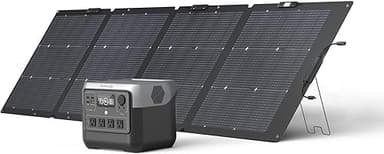
EcoFlow · RIVER 2 Pro + 220W
768 Wh · 800W output · 220W panel
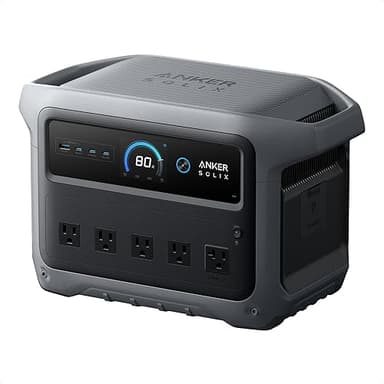
Step up to the Anker SOLIX C1000 Gen 2 (last checked $699.99 · checked Oct 19, 2026 · see on Amazon) and the math changes. With 1024Wh on tap, you get 13+ hours of heated-humidifier runtime — a full night with margin. The choice becomes real: run two nights with heat, or four nights without.
If you're buying a station primarily for home backup and occasional camping, a 1000Wh unit gives you the flexibility to prioritize comfort when it matters. If you're backpacking or weight-conscious, a 500Wh station works fine — but only if you're willing to disable the humidifier.
FAQ
How much power does a CPAP humidifier use?
Heated humidifiers typically draw 10-30W depending on heat setting, ambient temperature, and humidity level. When combined with a heated tube (another 5-15W), total humidification power can equal or exceed the CPAP blower's 30-40W draw. Cold, dry conditions push these numbers higher as the heating element works continuously.
Can I run just the humidifier without heat?
Yes, most CPAP machines support passover humidification — leaving the water tank attached with the heater disabled. You get ambient evaporative humidification with zero power draw beyond the blower. Effectiveness depends on room humidity; it works better in humid coastal or summer conditions than in dry winter or mountain environments. Check your machine's manual for the setting.
Is an HME as good as a heated humidifier?
Heat-Moisture-Exchanger (HME) filters capture your exhaled moisture and return it on inhale, mimicking humidification without power or water. Most users find them effective for short trips, though they add slight breathing resistance and require replacement every few nights. They won't match a heated humidifier's output in very dry conditions, but they're far better than nothing and use zero battery power.
Does the heated tube use much power?
Heated tubes add 5-15W to total system draw, depending on tube temperature setting and ambient conditions. That's roughly 40-120Wh over an eight-hour night — enough to cut a 500Wh battery's runtime by 10-25%. On cold nights when the tube's thermostat works hardest, the draw climbs toward the upper end of that range.
Why does my battery die faster on cold nights?
Cold ambient temperatures force both the humidifier heating plate and heated tube to work continuously to maintain set temperatures. The colder the air, the more heat energy required, and resistive heating elements respond by drawing more power. Cold also reduces battery capacity slightly (lithium chemistry loses 5-10% efficiency below freezing), compounding the problem. If you're camping in cold weather, expect 20-40% shorter runtime with heated humidification enabled.
Bottom line: If you're running a CPAP on a sub-1000Wh power station, turn off the heated humidifier and tube — you'll double your nights per charge. Test the setup at home first to confirm you tolerate it, and bring HME filters as backup. If you need heated humidification for compliance or comfort, buy a 1000Wh station and accept shorter runtime, or plan to recharge mid-trip with solar or AC. The physics don't negotiate: heat costs watts, and small batteries run out fast.