
Updated October 2026: the EcoFlow Delta 2 is no longer sold at Amazon (its listings now serve the Delta 3), so the Delta 3 replaces it in the table and picks. Same 1,024Wh capacity, so the night counts are unchanged.
The honest answer: one to four nights, depending on three settings you control, not the station you buy. A modern auto-CPAP without heated humidifier draws 30–40W on average and consumes 240–320Wh per night. Add heated humidification and that jumps to 440–560Wh per night. The power station capacity matters, but your humidifier and tube settings determine whether a 1000Wh station gives you one and a half nights or three and a half.
This article breaks down the Wh-per-night math, presents a nights-per-station runtime table for four common portable power stations, and explains the three variables that move the needle. To run the numbers for your exact machine and station, use our CPAP runtime calculator.
The Wh-per-Night Math by Setup
All figures below come from manufacturer power specifications for typical CPAP machines, not our testing. Check the label on your machine's power brick for your specific draw.
Humidifier off (modern auto-CPAP):
30–40W average × 8 hours = 240–320Wh per night
Heated humidifier on (no heated tube):
55–70W average × 8 hours = 440–560Wh per night
Heated humidifier + heated tube (cold-weather camping):
70–85W average × 8 hours = 560–680Wh per night
These are the watt-hours your CPAP itself draws. Inverter loss is accounted for once, on the capacity side: most portable power stations convert DC battery storage to AC and lose roughly 15% as heat, so we treat usable capacity as rated capacity × 0.85 in the table below. Applying the factor to both the nightly draw and the capacity would double-count it and understate runtime by about 18%. If you run your CPAP on 12V DC (when supported), you skip the inverter penalty entirely — covered in depth in our 12V DC vs AC inverter guide.
Nights Per Station: The Runtime Comparison Table
The table below shows estimated nights per charge, rounded down to half-night increments. Batteries don't negotiate at 3 a.m.—if you're 80% through night two and the station dies, you had one usable night, not two.
Usable capacity is rated capacity × 0.85 — the standard inverter-efficiency factor we use across the site. Rows are sorted by usable Wh.
| Station | Usable Wh | Humidifier Off (240–320 Wh/night) | Humidifier On (440–560 Wh/night) |
|---|---|---|---|
| EcoFlow River 2 Pro (768Wh bundle) | ~650 Wh | 2–2.5 nights | 1 night |
| EcoFlow Delta 3 | ~870 Wh | 2.5–3.5 nights | 1.5 nights |
| Anker SOLIX C1000 Gen 2 | ~870 Wh | 2.5–3.5 nights | 1.5 nights |
| Jackery Explorer 1000 v2 | ~910 Wh | 2.5–3.5 nights | 1.5–2 nights |
Assumptions: 0.85 inverter efficiency, applied once on the capacity side; 8-hour sleep; AC inverter use. Your mileage varies with pressure settings, ambient temperature, and actual machine wattage.
For a broader buying guide across price points and use cases, see our best power stations for CPAP guide.
What Changes the Math: The Three User-Controlled Variables
Ranked by impact on battery runtime:
1. Heated Humidifier and Tube
The single biggest battery killer. Heating water and air can double your power consumption—from 35W to 70W on many setups. If you're camping in moderate weather and can tolerate dry air, turn the humidifier off and double your nights per charge.
For the deep dive on humidifier power draw and strategies to reduce it, see why the humidifier is the battery killer.
2. AC Inverter vs. 12V DC
Running your CPAP on 12V DC (when your machine supports it) skips the inverter and saves roughly 15–20% of your battery capacity. Not all CPAP models offer DC input, and some require a specific cable. If yours does, the gain is meaningful over multi-night trips.
Full analysis in Running a CPAP on 12V DC vs the AC Inverter.
3. Pressure Setting
Higher pressure means the blower motor works harder, drawing more watts. But the effect is smaller than humidifier or inverter choices—usually 5–15W difference between low and high pressure. APAP (auto-adjusting) machines vary pressure breath-by-breath, averaging lower than fixed CPAP at high pressure, but the savings are modest.
Recharging Between Nights: Solar Pairing for Multi-Night Trips
For trips longer than your station's runtime, pair with a solar panel to recharge daily. A 200W panel in 4–5 hours of good sun realistically delivers 600–800Wh—enough to replace one humidifier-off night or partially refill after a humidified night.
Real-world solar output is lower than the panel's STC rating due to temperature, angle, and cloud cover. Plan for 60–75% of rated wattage in summer sun, less in shoulder seasons. For sizing details, see how many solar panels you actually need. For STC vs. real output, see what your panel really delivers.
Match panel input to your station's max solar input: the Anker SOLIX C1000 Gen 2 (last checked $699.99 · checked Oct 19, 2026 · see on Amazon) accepts up to 600W, while the EcoFlow River 2 Pro bundle (last checked $719.00 · checked Oct 19, 2026 · see on Amazon) ships with its own 220W panel out of the box.
Stations Compared: Which Runtime Fits Your Trip?
A 1,024Wh station estimates 1.5 nights at 60W for 8 hours on AC. Compare your measured overnight draw with rated Wh × 0.85, then round down to half nights. The station comparisons below use this same method; allow extra capacity for your circumstances.
| Spec | Anker SOLIX C1000 Gen 2 | Jackery Explorer 1000 v2 | EcoFlow River 2 Pro Solar Generator (220W) | EcoFlow DELTA 3 Portable Power Station |
|---|---|---|---|---|
| Capacity | 1024 Wh | 1070 Wh | 768 Wh | 1024 Wh |
| Continuous Output | 2000 W | 1500 W | 800 W | 1800 W |
| Surge Output | 3000 W | 3000 W | 1600 W | 3600 W |
| Weight | 24.9 lbs | 23.8 lbs | — | 27.6 lbs |
| Battery Chemistry | LiFePO4 | LiFePO4 | LiFePO4 | LiFePO4 |
| Cycle Life | 4000 cycles | 4000 cycles | — | 4000 cycles |
| Recharge Time | 49 min | 60 min | — | 56 min |
| Max Solar Input | 600 W | 400 W | — | 500 W |
| Included Panel | — | — | 220 W | — |
| Outlets | 6 AC · 1 Car · 2 USB-A · 2 USB-C | — | — | — |
Anker SOLIX C1000 Gen 2
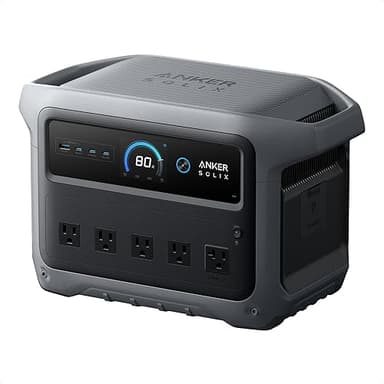
1024Wh rated, ~870Wh usable. Expect two-and-a-half to three-and-a-half humidifier-off nights, or about one-and-a-half with humidifier on. The 600W solar input and 49-minute AC recharge make it the fastest to top off between nights. 4000-cycle LiFePO4 chemistry means it will outlast most camping tents.
Jackery Explorer 1000 v2
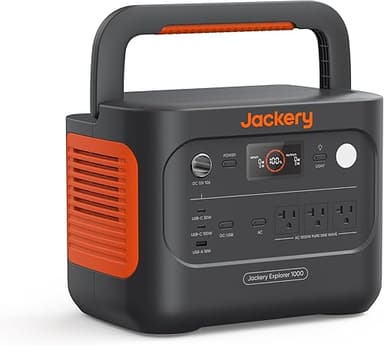
1070Wh rated, ~910Wh usable—the highest capacity in the 1kWh class. The extra 40Wh is worth about an eighth of a night over the Delta 3 and C1000, and can push a humidified trip from one-and-a-half nights to two. Same LiFePO4 4000-cycle lifespan, 400W solar input, and 1500W output for other camp loads.
EcoFlow Delta 3
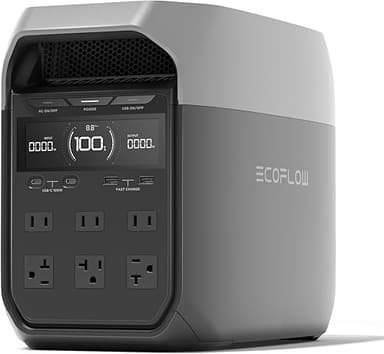
1024Wh rated, ~870Wh usable. Nearly identical runtime to the C1000 Gen 2. The 1800W output (3600W surge) and 500W solar input make it versatile for mixed loads (CPAP plus camp fridge, lights, etc.), and the battery is rated for 4000 cycles, matching the Anker and Jackery. It replaced the Delta 2, which is no longer sold at Amazon.
EcoFlow River 2 Pro Solar Generator
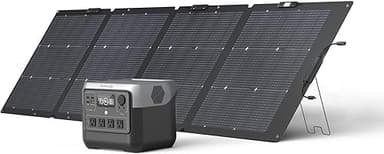
EcoFlow · RIVER 2 Pro + 220W
768 Wh · 800W output · 220W panel
768Wh rated, ~650Wh usable — the smallest in-stock unit we track, and the only one here that ships as a bundle with its own 220W solar panel. One humidified night with a little margin, or up to two-and-a-half nights without. The 800W pure sine output is far more than any CPAP needs, and the included panel can replace a humidifier-off night in a few hours of good sun — which makes it the natural multi-night pick at the budget end. LiFePO4 chemistry for long cycle life.
Availability note: the 500Wh-class stations we previously tracked in this tier (Bluetti AC60P, Goal Zero Yeti 500X) are currently unavailable at Amazon.
Recommendations
For weekend camping with humidifier off, the EcoFlow River 2 Pro Solar Generator (last checked $719.00 · checked Oct 19, 2026 · see on Amazon) delivers up to two-and-a-half nights, and its bundled 220W panel resets the battery daily — the lightest and most affordable path in our current lineup.
For multi-night trips or humidifier-on use, step up to 1kWh: the Jackery Explorer 1000 v2 (last checked $499.00 · checked Oct 20, 2026 · see on Amazon) has the highest usable capacity, the Anker SOLIX C1000 Gen 2 (last checked $699.99 · checked Oct 19, 2026 · see on Amazon) recharges fastest, and the EcoFlow Delta 3 (last checked $629.00 · checked Oct 19, 2026 · see on Amazon) handles the highest mixed AC loads.
Cold-weather or heated-tube users: budget for 560–680Wh per night. Even the 1kWh stations give you one-and-a-half nights max. Plan on solar recharge or a second battery.
How much power does a CPAP use?
Most CPAP machines draw 30-90W depending on settings, per manufacturer power specifications. A modern auto-CPAP with humidifier off averages 30-40W. Add a heated humidifier and the draw roughly doubles to 55-70W; a heated tube on top pushes it to 70-85W. Over an 8-hour night that's 240-320Wh without humidification, or 440-680Wh with heating enabled. Your machine's power brick lists the maximum (e.g., 24V × 3.75A = 90W), but real overnight draw usually runs 40-70% of that — measure with a plug-in watt meter for your exact number. Manufacturer typical and peak figures by model are collected in CPAP machine wattage by model.
How many nights will a 1000Wh power station run a CPAP?
Two-and-a-half to three-and-a-half nights with humidifier off (240–320Wh per night), or about one-and-a-half nights with heated humidifier on (440–560Wh per night). Actual nights depend on your machine's wattage, pressure setting, and whether you run AC or DC. Usable capacity is rated Wh × 0.85, so a 1000Wh station delivers about 850Wh to your CPAP after inverter loss.
Can a 500Wh power station run a CPAP overnight?
With humidifier off, yes — one to one-and-a-half nights is realistic (~425Wh usable vs 240–320Wh per night). With the heated humidifier on, a full 8-hour night doesn't quite work: the 440–560Wh range exceeds ~425Wh usable, so it only works if your setup sits at the low end of the draw range or the night runs short. Treat 500Wh as a humidifier-off class. Note that the 500Wh models we track are currently unavailable at Amazon — the smallest in-stock option is the 768Wh EcoFlow River 2 Pro bundle (last checked $719.00 · checked Oct 19, 2026 · see on Amazon), which handles one humidified night with margin.
Do I need pure sine wave for a CPAP?
Yes. CPAP blower motors and power bricks expect clean AC waveform. Modified sine wave inverters can cause motor whine, overheating, or outright failure. Every station in this article uses pure sine wave inverters. Never run a CPAP on a modified sine wave or you risk voiding the warranty and damaging the machine.
How do I find my CPAP machine's real power draw?
Check the label on your machine's power brick for input voltage and amperage (e.g., 24V DC, 3.75A = 90W max). Real draw during sleep is typically 40–70% of max, depending on pressure and humidifier. For precision, use an inexpensive plug-in watt meter (e.g., a Kill A Watt) between the power station AC outlet and your CPAP brick. Run it overnight and note the Wh reading in the morning.
Does APAP use less power than fixed CPAP?
Slightly. Auto-adjusting pressure (APAP) lowers blower speed during exhalation and light-pressure phases, averaging 5–15W less than fixed CPAP at high pressure. Over an 8-hour night, that saves 40–120Wh—enough to extend a 500Wh station from one night to one-and-a-quarter. The effect is real but smaller than turning off the humidifier or switching to DC.
Will cold weather reduce my CPAP runtime on a power station?
Yes, in two ways. First, LiFePO4 and Li-ion batteries lose 10–20% capacity below freezing (keep the station inside your tent or sleeping bag). Second, cold air makes heated humidifiers and tubes work harder, raising power draw by 10–25W. A humidified setup that draws 60W at 70°F may pull 75W at 32°F, cutting your nights from two to one-and-a-half.