
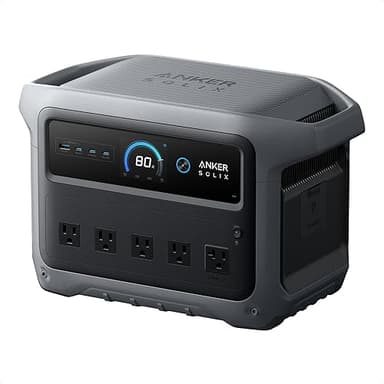
Our Review
The best all-around 1000Wh power station for most people — fastest recharge in its class, a 4,000-cycle battery, and enough output to run almost anything you'd plug in at a campsite or during an outage.
Specifications
| Capacity | 1024 Wh |
|---|---|
| Continuous output | 2000 W |
| Surge output | 3000 W |
| Battery chemistry | LiFePO4 |
| Cycle life (to 80%) | 4000 cycles |
| AC recharge | 49 min |
| Max solar input | 600 W |
| Weight | 24.9 lbs |
The SOLIX C1000 Gen 2 is the station we point most readers to first, and it earns that by being excellent at the things that actually matter day to day rather than chasing a single headline spec.
Its 1024Wh LiFePO4 battery hits the sweet spot: enough to run a 60W CPAP for roughly 14 hours, a full-size fridge for 12–14, or a weekend of phone/laptop/light duty without a recharge. The 2000W output (3000W surge) starts compressors and high-wattage gear that trip lesser 1000Wh units — see our breakdown of why that surge headroom matters in Surge Watts vs Running Watts.
It takes up to 600W of solar for a quick off-grid top-up, and weighs 24.9 lbs — portable, but not the lightest in class. One gap on the spec sheet: Anker doesn't publish an IP dust or water rating for this unit, so keep it under cover in wet conditions.
Two specs separate it from the pack. The 49-minute full recharge is the fastest we've seen at this capacity, which quietly changes how you use it — you can top up during a lunch stop instead of planning around a multi-hour charge. And the 4,000-cycle rating means the battery outlasts the rest of the unit; cycle life is the spec that decides whether a station lasts 3 years or 12, which we cover in LiFePO4 vs NMC.
Pros
- Fastest-in-class 49-minute recharge
- 4,000-cycle LiFePO4 battery
- 2,000W output (3,000W surge) runs a full-size fridge
- 600W solar input for quick off-grid top-ups
Cons
- 24.9 lbs — portable but not featherweight
- No published IP weather rating
What it actually runs
A full 1024Wh charge delivers roughly 870Wh after inverter losses — here's what that means in practice:
| Device | Typical draw | Runtime per charge |
|---|---|---|
| CPAP (humidifier on) | 60W | ~14 hours (1.5 nights) |
| Full-size fridge | ~65W avg* | ~13 hours |
| 65″ LED TV | 100W | ~8.5 hours |
| Laptop | 50W | ~17 hours |
| Phone top-ups | 15Wh each | ~55 charges |
*A fridge's compressor cycles on and off, so its average draw sits far below the nameplate watts — the surge-vs-running-watts gap that decides whether a station can start one at all.
Can the Anker SOLIX C1000 Gen 2 run a refrigerator?
Yes. The 2,000W output (3,000W surge) starts a full-size fridge compressor, and the 1024Wh battery keeps one running for roughly 13 hours of normal cycling — enough to cover most outages, and longer if you limit door openings.
Can you run devices while it charges?
Yes. The C1000 Gen 2 supports pass-through power, so you can run your gear from the outlets while the battery recharges from wall or solar at the same time.
Who it's for: weekend campers, van lifers, and anyone who wants one station that covers camping and home backup. If you only need a single night of occasional backup, a 500Wh unit is half the price — but the C1000 Gen 2 is the one you won't outgrow.