
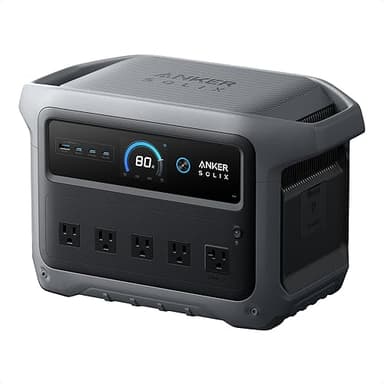
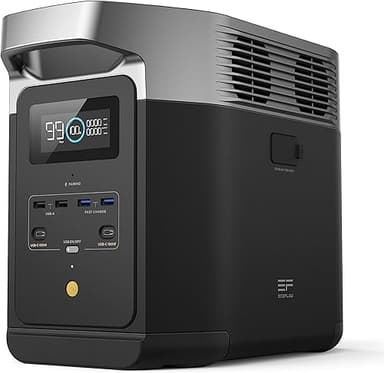
Both are 1,024Wh LiFePO4 stations aimed squarely at the same buyer, so this comes down to whether you value hardware specs or software polish.
The Anker leads on the numbers. It recharges in 49 minutes versus the Delta 2's 80, pushes 2,000W (3,000W surge) versus 1,800W (2,700W), takes 600W of solar versus 500W, and its 4,000-cycle battery outlasts the Delta 2's 3,000 — the spec that most affects long-term value (LiFePO4 vs NMC). On paper, the C1000 Gen 2 is the stronger unit.
The EcoFlow leads on software. Its app is genuinely the best in the category — real-time power-draw monitoring (the easiest way to learn what your gear actually pulls), charge-rate control, and outlet timers. It's also expandable with add-on batteries, where the C1000 is a fixed-capacity unit.
C1000 Gen 2 vs Delta 2: the spec sheet side by side
Every figure below is the manufacturer's rating. Where a number is our arithmetic, the formula is stated underneath.
| Spec | Anker SOLIX C1000 Gen 2 | EcoFlow Delta 2 | Edge |
|---|---|---|---|
| Rated capacity | 1,024Wh | 1,024Wh | Tie |
| Usable capacity (× 0.85) | ~870Wh | ~870Wh | Tie |
| Running watts | 2,000W | 1,800W | Anker |
| Surge watts | 3,000W | 2,700W | Anker |
| Battery chemistry | LiFePO4 | LiFePO4 | Tie |
| Rated cycle life | 4,000 cycles | 3,000 cycles | Anker |
| AC recharge to full (rated) | 49 minutes | 80 minutes | Anker |
| Max solar input | 600W | 500W | Anker |
| Advertised UPS switchover | 10ms, all AC outlets | 30ms | Anker |
| Weight | 24.9 lbs | 27 lbs | Anker |
| Companion app | Yes | Best in category | EcoFlow |
Usable Wh = rated Wh × 0.85 (inverter loss, applied once — how we calculate runtime).
Same battery size, so runtime is a tie: a 60W CPAP runs about 14.5 hours on either one (870Wh ÷ 60W), which is 1.5 nights at 8 hours. The differences are all in how fast each station refills, how much it can push, and how it handles an outage.
Recharge: wall and solar
On AC, the Anker's rated 49 minutes to full is the fastest we track at this capacity, against the Delta 2's 80. In a rolling-blackout week, that's the difference between topping up during a two-hour grid window with time to spare and cutting it close.
On solar, the Anker also leads. At our planning multiplier — real solar watts = rated panel watts × 0.65 — an array sized to each unit's maximum input gives:
- C1000 Gen 2: 1,024Wh ÷ (600W × 0.65) ≈ 2.6 hours of full sun
- Delta 2: 1,024Wh ÷ (500W × 0.65) ≈ 3.2 hours of full sun
Either refills inside 4–5 peak sun hours, a common planning figure for much of the US. Model your own panels in the solar recharge calculator.
As a UPS: 10ms vs 30ms
This is the widest gap between the two and the one most buyers miss. Anker states a 10ms switchover on all AC outlets for the C1000 Gen 2; EcoFlow quotes 30ms for the Delta 2. Most desktop PC power supplies can bridge only 16–20ms of lost power. So on paper, the Anker sits inside that window and the Delta 2 sits outside it. A desktop plugged into the Delta 2 is likely to reboot when the grid drops.
Both figures are manufacturer claims with no stated load, so test with your own hardware before trusting either with unsaved work. For routers, modems, laptops, and CPAPs, both are fine. The full model-by-model table is in Can a Power Station Replace a UPS?.
FAQ
Is the Anker SOLIX C1000 Gen 2 better than the EcoFlow Delta 2?
On hardware, yes. It has more output (2,000W vs 1,800W), a faster rated recharge (49 vs 80 minutes), more solar input (600W vs 500W), a longer-rated battery (4,000 vs 3,000 cycles), and a shorter advertised switchover (10ms vs 30ms). The Delta 2's advantage is its app.
Which runs a CPAP longer?
Neither. Both are 1,024Wh, so both give about 870Wh usable, or around 14.5 hours on a 60W CPAP. The Anker's shorter switchover is the tiebreaker if the CPAP stays plugged in through an outage. Sizing by CPAP model is in our CPAP battery backup guide.
Which is better as a UPS for a computer?
The C1000 Gen 2. Its advertised 10ms switchover is under the 16–20ms most desktop power supplies can bridge. The Delta 2's 30ms is over it.
Which is lighter?
The Anker, at 24.9 lbs against the Delta 2's 27 lbs.
Who should buy which
Best for most buyers: Anker SOLIX C1000 Gen 2 (see on Amazon). Home backup, CPAP, camping, or a station that sits in front of a desktop. It wins every hardware row we compare. Don't buy it if live power data and app control are the main reason you want a station.
Best for data-minded users: EcoFlow Delta 2. The app is the best in the category for learning what your gear actually draws, and EcoFlow sells add-on batteries for it. Don't buy it if you need a desktop PC to ride through an outage, or you want the fastest refill.
Also cross-shopping the Jackery? See Delta 2 vs Jackery Explorer 1000 v2 and C1000 Gen 2 vs Jackery 1000 v2.