
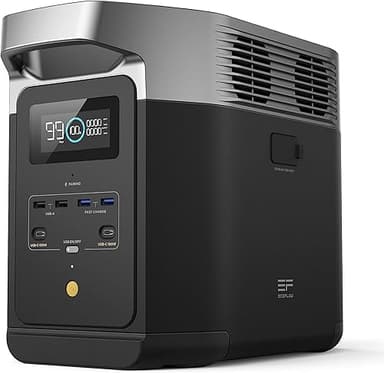
Our Review
A versatile 1024Wh station that trades a little recharge speed for the best app in the category and an expandable-battery path — the pick for tech-minded users who want data and room to grow.
Specifications
| Capacity | 1024 Wh |
|---|---|
| Continuous output | 1800 W |
| Surge output | 2700 W |
| Battery chemistry | LiFePO4 |
| Cycle life (to 80%) | 3000 cycles |
| AC recharge | 80 min |
| Max solar input | 500 W |
| Weight | 27 lbs |
The Delta 2 matches the class leaders on the fundamentals — 1024Wh, 1800W output (2700W surge), LiFePO4 chemistry — and differentiates on software and expandability rather than raw numbers.
EcoFlow's app is genuinely the best in the segment. Real-time draw monitoring is more useful than it sounds: it's the easiest way to learn what your gear actually pulls, which is the first step in sizing any setup (see Surge Watts vs Running Watts). You can also cap charge speed to protect the battery and set outlet timers.
Its X-Boost feature runs higher-wattage resistive loads (heaters, kettles) by trimming voltage — handy, though it won't defeat a compressor's startup surge, so don't expect it to rescue an undersized station on a fridge. The 80-minute recharge trails the Anker C1000's 49 minutes, and at 3,000 cycles the battery is rated lower than the Anker's 4,000 (still triple what older NMC units delivered — context in LiFePO4 vs NMC). At 27 lbs it's also the heaviest 1000Wh-class station we track, next to the Anker C1000 Gen 2's 24.9 lbs and the Jackery Explorer 1000 v2's 23.8.
Pros
- Best-in-class companion app with live power data
- Expandable with add-on batteries (up to ~3kWh)
- X-Boost for high-wattage resistive devices
Cons
- 80-minute recharge — slower than the C1000 Gen 2
- 3,000-cycle battery vs the Anker C1000 Gen 2's 4,000
- 27 lbs — heaviest in the 1000Wh class we track
What it actually runs
A full 1024Wh charge gives about 870Wh usable:
| Device | Typical draw | Runtime per charge |
|---|---|---|
| CPAP (humidifier on) | 60W | ~14 hours (1.5 nights) |
| Full-size fridge | ~65W avg | ~13 hours |
| 65″ LED TV | 100W | ~8.5 hours |
| Laptop | 50W | ~17 hours |
| Phone top-ups | 15Wh each | ~55 charges |
The companion app shows each device's real draw, so you can verify these for your own gear.
Can the EcoFlow Delta 2 run a fridge?
Yes — 1,800W output (2,700W surge) starts a standard fridge, and the 1024Wh battery keeps one cold for around 13 hours of cycling.
Can I add more battery later?
Yes. The Delta 2 accepts add-on batteries to roughly triple its capacity, so you can start small and expand if your needs grow.
Who it's for: users who want app control, data logging, and the option to bolt on more capacity later. If you'd rather have the fastest recharge and longest battery life in a simpler package, compare it against the Anker SOLIX C1000 Gen 2 (last checked $499.99 · checked Oct 26, 2026 · see on Amazon).