
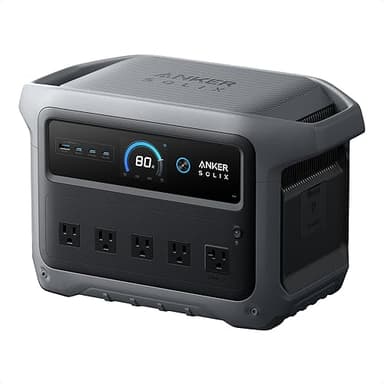
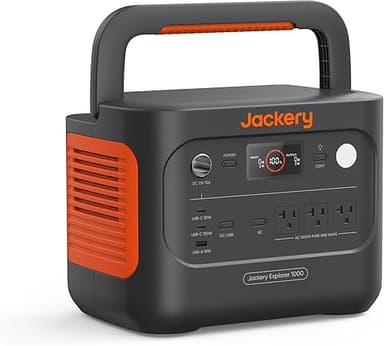
This is a close one — both are our top-tier 1,000Wh picks, both use a long-lived 4,000-cycle LiFePO4 battery, and both weigh about 24 lbs. They differ mainly in output and ecosystem.
The Anker has more muscle. 2,000W output (3,000W surge) versus the Jackery's 1,500W (3,000W surge) gives it more headroom to run high-wattage appliances and stack devices — useful if you'll run a fridge plus other loads (see Surge Watts vs Running Watts). It also recharges faster (49 vs 60 minutes) and takes more solar (600W vs 400W), so it tops up quicker both on the wall and off-grid.
The Jackery wins on simplicity. It's marginally lighter, and Jackery's retail presence (Costco, Target) makes returns and warranty claims easier than online-first brands — a real consideration for a several-hundred-dollar purchase you might need to service.
C1000 Gen 2 vs Jackery 1000 v2: the spec sheet side by side
Every figure below is the manufacturer's rating. Where a number is our arithmetic, the formula is stated underneath.
| Spec | Anker SOLIX C1000 Gen 2 | Jackery Explorer 1000 v2 | Edge |
|---|---|---|---|
| Rated capacity | 1,024Wh | 1,070Wh | Jackery (+46Wh) |
| Usable capacity (× 0.85) | ~870Wh | ~910Wh | Jackery |
| Running watts | 2,000W | 1,500W | Anker |
| Surge watts | 3,000W | 3,000W | Tie |
| Battery chemistry | LiFePO4 | LiFePO4 | Tie |
| Rated cycle life | 4,000 cycles | 4,000 cycles | Tie |
| AC recharge to full (rated) | 49 minutes | 60 minutes | Anker |
| Max solar input | 600W | 400W | Anker |
| Advertised UPS switchover | 10ms, all AC outlets | ~20ms | Anker |
| Weight | 24.9 lbs | 23.8 lbs | Jackery |
Usable Wh = rated Wh × 0.85 (inverter loss, applied once — how we calculate runtime).
What each one actually runs
Runtime = usable Wh ÷ device watts, with device draw used as-is.
| Load | Typical draw | Anker C1000 Gen 2 (~870Wh) | Jackery 1000 v2 (~910Wh) |
|---|---|---|---|
| CPAP, humidifier on | 60W | ~14.5 hours (1.5 nights at 8 hrs) | ~15 hours (1.5 nights at 8 hrs) |
| Router + modem | 20W | ~43 hours | ~45 hours |
| Laptop | 60W | ~14.5 hours | ~15 hours |
The Jackery's extra 46Wh buys about half an hour on a CPAP, which isn't enough for another night. The output gap matters more. A 1,600–1,800W appliance, such as a kettle or a space heater on high, runs on the Anker and trips the Jackery. Check your own devices with the CPAP runtime calculator or the surge sizer.
Recharge: wall and solar
On AC, the Anker is rated at 49 minutes to full and the Jackery at 60. The practical difference is small. On solar, it's wider. At our planning multiplier — real solar watts = rated panel watts × 0.65 — an array sized to each unit's maximum input gives:
- C1000 Gen 2: 1,024Wh ÷ (600W × 0.65) ≈ 2.6 hours of full sun
- Jackery 1000 v2: 1,070Wh ÷ (400W × 0.65) ≈ 4.1 hours of full sun
That's a morning versus most of a clear day. If you'll recharge from panels regularly, it's the Anker's biggest advantage. Model your own panels in the solar recharge calculator.
As a UPS: 10ms vs ~20ms
Anker states a 10ms switchover on all AC outlets for the C1000 Gen 2, and Jackery gives about 20ms for the 1000 v2. A shorter advertised transfer gives sensitive equipment more margin, but desktop hold-up time varies by PSU and load. Neither figure guarantees that a PC, router, or CPAP will keep running. Check the connected equipment's requirements. More detail in UPS transfer times by model.
FAQ
Is the Anker SOLIX C1000 Gen 2 better than the Jackery Explorer 1000 v2?
For most uses, yes. It has 500W more running output, faster wall and solar charging, and a shorter advertised switchover. The Jackery holds slightly more usable energy (~910Wh vs ~870Wh) and is 1.1 lbs lighter. Both are rated for 4,000 cycles.
Which is better for a CPAP?
It's close. The Jackery runs a 60W CPAP about 15 hours, and the Anker about 14.5. That's 1.5 nights at 8 hours on either. If the CPAP stays plugged in during an outage, the Anker's 10ms switchover is the safer figure. Full sizing by CPAP model is in our CPAP battery backup guide.
Which lasts longer?
Per charge, the Jackery, by about 40Wh usable. Over its lifetime it's a tie: both are rated for 4,000 cycles, roughly 11 years at one full cycle a day.
Which charges faster from solar?
The Anker. It accepts 600W against the Jackery's 400W, roughly 2.6 vs 4.1 hours of full sun with a matched array at our 0.65 planning multiplier.
Who should buy which
Best for most buyers: Anker SOLIX C1000 Gen 2 (last checked $499.99 · checked Oct 26, 2026 · see on Amazon). More output, faster solar refills, and the shortest advertised switchover of the 1,000Wh stations we track. Don't buy it if the lightest possible carry or in-store returns matter more to you than output.
Best for light carry and local returns: Jackery Explorer 1000 v2 (last checked $499.00 · checked Oct 20, 2026 · see on Amazon). Slightly more usable capacity, the same rated battery life, and a brand you can return to a local store. Don't buy it if you'll run anything over 1,500W or recharge mostly from solar.
Also weighing the EcoFlow? See Delta 3 vs Jackery 1000 v2; the Delta 3 replaced the Delta 2, which is no longer sold at Amazon.