
Our Review
The lightest 1000Wh-class station with a 4,000-cycle battery and easy retail returns — the buy-it-for-life value pick, as long as you don't need to run the highest-wattage appliances.
Specifications
| Capacity | 1070 Wh |
|---|---|
| Continuous output | 1500 W |
| Surge output | 3000 W |
| Battery chemistry | LiFePO4 |
| Cycle life (to 80%) | 4000 cycles |
| AC recharge | 60 min |
| Max solar input | 400 W |
| Weight | 23.8 lbs |
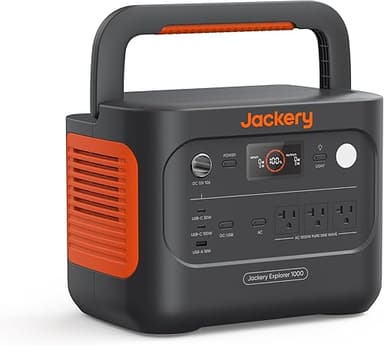
The Explorer 1000 v2 is Jackery's answer to a crowded segment, and it competes on longevity, weight, and the reassurance of buying from a brand you can return to a local store.
At 23.8 lbs it's the lightest in the 1000Wh class, and its 1070Wh LiFePO4 pack edges out rivals slightly on capacity — about 15 hours on a 60W CPAP — a night and a half. The 2025–2026 redesign brought a 60-minute recharge (up from 90+ on the v1) and a 4,000-cycle battery that matches the best in class for lifespan — the spec that, as we explain in LiFePO4 vs NMC, really decides long-term value.
The one tradeoff is output: 1500W continuous (3000W surge) is lower than the 1800–2000W rivals. It still starts a typical fridge, but it has less headroom for stacking high-draw devices — worth understanding via Surge Watts vs Running Watts before you count on it for a heavy load. Solar input is modest too — 400W, versus 600W on the step-up Anker SOLIX C1000 Gen 2 (last checked $499.99 · checked Oct 26, 2026 · see on Amazon) — fine for a single panel, but it caps how fast you can refill off-grid.
Pros
- Lightest 1000Wh-class station at 23.8 lbs
- 4,000-cycle LiFePO4 for a long service life
- Retail availability for easy returns and warranty
- 60-minute recharge
Cons
- 1,500W output — less headroom than 1800–2000W rivals
- 400W solar input trails the C1000's 600W
What it actually runs
A full 1070Wh charge yields about 910Wh usable:
| Device | Typical draw | Runtime per charge |
|---|---|---|
| CPAP (humidifier on) | 60W | ~15 hours (1.5 nights) |
| Full-size fridge | ~65W avg | ~14 hours |
| 65″ LED TV | 100W | ~9 hours |
| Laptop | 50W | ~18 hours |
| Phone top-ups | 15Wh each | ~60 charges |
Can the Jackery Explorer 1000 v2 run a refrigerator?
Yes. Its 1,500W output starts a typical fridge (3,000W surge), and the 1070Wh battery keeps one cold for around 14 hours of cycling. Very high-surge compressors are the exception — check the nameplate first.
Is it light enough to carry?
At 23.8 lbs it's the lightest in the 1000Wh class — a one-hand carry for most people, which is part of why it's a favorite for camping and quick grab-and-go backup.
Who it's for: buyers who prioritize longevity, light weight, and hassle-free returns over maximum output. If you need to run higher-wattage appliances or want faster solar/AC charging, weigh it against the Anker SOLIX C1000 Gen 2 (last checked $499.99 · checked Oct 26, 2026 · see on Amazon).