
The power goes out halfway through the night. Your CPAP stops, and a battery with enough output watts can still run out before morning if it lacks the watt-hours. Choosing a portable power station for CPAP starts with your machine's overnight energy use and the number of nights you need between charges.
Start with the 1kWh class: the Anker SOLIX C1000 Gen 2 (last checked $499.99 · checked Oct 26, 2026 · see on Amazon) is our fast-recharge pick; the Jackery Explorer 1000 v2 (last checked $499.00 · checked Oct 20, 2026 · see on Amazon) is the lighter alternative at 23.8 lbs. Both calculate to 1.5 eight-hour nights at 60W, or 2.5 at 40W, using our AC planning model. For two or more nights at 60W without recharging, the EcoFlow Delta 2 Max (last checked $1049.00 · checked Oct 19, 2026 · see on Amazon) calculates to 3.5 nights. These are estimates from specs, not measured runtimes or confirmation that a station will keep your particular CPAP running through an outage.
Before buying a portable power station for your CPAP machine, check three things: capacity at your usual settings, a manufacturer-compatible power connection, and whether you need manual backup or automatic switchover. A solar-generator bundle adds a panel; it does not add battery capacity. Compare the River 2 Pro panel bundle (last checked $719.00 · checked Oct 19, 2026 · see on Amazon) with other bundles rather than treating it as the cheapest standalone station.
Run your own numbers: the CPAP runtime calculator turns your machine's wattage, your sleep length, and any station's capacity into nights per charge — on the same half-night-rounding method this guide uses. Don't know your wattage? CPAP machine wattage by model lists the manufacturer figures by model.
Corrected October 20, 2026: aligned quick-pick runtimes with the calculation tables, separated outage switchover from battery runtime, and removed claims of guaranteed silence, uninterrupted CPAP operation, and loss-free DC operation. Offers without a recent recorded check are withheld until reverified; this article update is not a new retailer price check.
Compare CPAP Power Stations at a Glance
Estimated 8-hour nights on AC: rated Wh × 0.85 ÷ (watts × 8), rounded down to half nights. These are calculations, not measured runtimes or compatibility checks. Offers older than 14 days are withheld until rechecked; confirm price and availability on Amazon.
| Product / use | Weight | 40W nights | 60W nights | 90W nights | Amazon offer |
|---|---|---|---|---|---|
| Anker SOLIX C1000 Gen 2Fast AC recharge | 24.9 lbs | 2.5 | 1.5 | 1 | $499.99Checked Oct 26, 2026Check Amazon price for Anker SOLIX C1000 Gen 2 |
| Jackery Explorer 1000 v2Lightweight 1kWh station | 23.8 lbs | 2.5 | 1.5 | 1 | $499.00Checked Oct 20, 2026Check Amazon price for Jackery Explorer 1000 v2 |
| EcoFlow DELTA 3 Portable Power StationExpandable 1kWh station | 27.6 lbs | 2.5 | 1.5 | 1 | $629.00Checked Oct 19, 2026Check Amazon price for EcoFlow DELTA 3 Portable Power Station |
| EcoFlow Delta 2 MaxMulti-night trips | 50 lbs | 5 | 3.5 | 2 | $1049.00Checked Oct 19, 2026Check Amazon price for EcoFlow Delta 2 Max |
| EcoFlow River 2 Pro Solar Generator (220W)Station + 220W panel bundle | Not recorded | 2 | 1 | 0.5 | $719.00Checked Oct 19, 2026Check Amazon price for EcoFlow River 2 Pro Solar Generator (220W) |
The River 2 Pro includes a panel; compare it with other bundles when judging price. Check your machine’s power requirements and allow a capacity margin before buying.
How We Picked
We calculated runtime from each power station's rated capacity multiplied by 85% inverter efficiency, then compared estimates against three common CPAP draw scenarios: 40W (no humidification), 60W (light humidifier), and 90W (heated hose plus humidifier).
We prioritized:
- LiFePO4 chemistry — longer cycle life and better thermal stability than older lithium-ion
- Power connection — compare AC output specifications with the CPAP manufacturer's requirements; a waveform specification alone does not establish compatibility
- Practical overnight capacity — at least one full 8-hour night for typical CPAP use
- Bedside practicality — weight, controls, and published cooling information; we have not measured fan noise
- Solar input compatibility — for multi-day off-grid use
- Manufacturer warranty and support — affiliate convenience matters less than long-term reliability
We did not perform hands-on testing of the units in this guide. Runtime numbers are calculated from manufacturer-published specs and a standard 0.85 inverter efficiency factor, not measured in the field. Real-world runtime varies based on temperature, battery age, and exact CPAP power draw.
CPAP Battery Backup: Dedicated CPAP Battery vs Portable Power Station
Two product categories answer the same search, and they are not interchangeable.
A dedicated CPAP battery is designed for a supported set of CPAP devices and connections. Compare the manufacturer's runtime at your prescribed settings, required adapters, heating limits, and any documented backup function. Do not apply a mains-power wattage estimate to a dedicated DC battery and assume the two systems have the same losses. If flying, check the battery's watt-hour rating and your airline's current rules before buying.
A portable power station offers a larger general-purpose battery and AC outlets, with model-specific DC and solar inputs. The stations below span 768–2,048Wh. They can also supply other compatible loads, but every additional device reduces CPAP runtime. They are heavier than many dedicated batteries, and solar recharge depends on the panel, station limits, and available sun.
The decision: compare a supported dedicated battery when carrying weight matters most. Compare power stations when you need more stored energy or additional compatible outlets. Heating use, outage duration, and the exact connection determine the capacity required; the product category alone does not establish suitability. Everything below focuses on the power-station option.
Quick Picks
How to Size a Power Station for Your CPAP
CPAP power consumption varies based on three factors: pressure setting, humidifier use, and whether you use a heated hose. Most CPAPs run between 30-90W.
For the full nights-per-station runtime table, see How Many Nights Will a Power Station Run a CPAP?. Heated humidification changes the energy requirement substantially (humidifier energy use). A compatible DC converter instead of the AC inverter can reduce conversion losses, but its efficiency and connector requirements depend on the device. Keep your prescribed therapy settings when sizing the battery.
The sizing formula:
(CPAP watts × hours of use) ÷ 0.85 = minimum Wh capacity
Or skip the arithmetic: our CPAP runtime calculator runs this math for any wattage, sleep length, and station capacity. Not sure of your wattage? CPAP machine wattage by model lists the manufacturer typical and peak figures by model.
The 0.85 accounts for inverter efficiency loss — power stations convert DC battery power to AC, losing about 15% in the process.
Runtime Examples by CPAP Wattage
| CPAP Power | 8 Hours (1 Night) | 16 Hours (2 Nights) | Recommended Minimum |
|---|---|---|---|
| 40W planning example | 377 Wh | 753 Wh | 500 Wh station for one night |
| 60W planning example | 565 Wh | 1,130 Wh | 1,000 Wh station for one night |
| 90W planning example | 848 Wh | 1,695 Wh | 1,500+ Wh station for one night |
Finding your CPAP's wattage:
- Read the manufacturer's power requirements for your exact CPAP and accessories.
- Treat the power brick's voltage × current as its rated output limit, not average overnight consumption.
- Measure energy over a representative night with a plug-in watt meter and your usual prescribed settings. Divide watt-hours by hours to estimate average watts.
- Include humidifier and heated-tube use in that measurement; do not add their draw a second time.
Many full-size CPAPs ship with 65W to 90W power supplies, but actual overnight draw is often lower. Without heated humidification or tubing, expect 30-60W. With heating enabled, expect 60-100W. The only way to know your machine precisely is to measure it with a Kill-A-Watt meter.
Safety Margin
Use at least 20% extra rated capacity as a planning reserve beyond the model's minimum. If the calculation gives 565Wh, that means at least 678Wh before rounding up to a product size. This reserve is separate from the 0.85 factor and is not included in the comparison's night counts. Allow more where your equipment provider recommends it, because of:
- Battery degradation over time
- Temperature-dependent capacity and operating limits
- Running other devices (phone charging, lights)
- Manufacturer capacity ratings measured under ideal conditions
CPAP Battery Backup for a Power Outage
Choose capacity and continuity separately. A station can have enough energy for a night and still interrupt your CPAP when grid power fails. We have not tested these stations with your CPAP or verified their transfer behavior on medical equipment.
Manual backup: keep a charged station ready to connect after an outage. Therapy is interrupted until the setup is restored. Verify the correct power supply or converter, accessible connections, and enough capacity at your prescribed settings.
Automatic switchover through a station's UPS/EPS mode: the station is designed to transfer from grid power to battery, but an interruption may still occur. Verify the exact model's transfer specification, pass-through limits, low-load shutoff settings, and whether both manufacturers support your intended use.
Manufacturer-supported CPAP battery setup: behavior depends on the specific battery, device, and connection. Verify supported CPAP models, required adapters, runtime with heating enabled, and any documented backup or switching function.
Size for the whole outage
For two eight-hour nights at 60W, the CPAP needs 960Wh. The AC model requires 960 ÷ 0.85 = 1,130Wh rated capacity, rounding up. A separate 20% planning reserve raises that to 1,356Wh. The 1,024Wh Anker and Delta 3 and the 1,070Wh Jackery therefore do not meet that two-night target without recharging. The 2,048Wh Delta 2 Max calculates to 3.5 nights at 60W before any separate reserve.
At 90W, two nights need 1,440Wh, or 1,695Wh rated capacity under the AC model. With the separate 20% reserve, plan for at least 2,033Wh. Reserve calculations use the unrounded model minimum before rounding up. The 768Wh River bundle calculates to about 7.3 hours at 90W, short of one eight-hour night. Choose against your measured draw rather than assuming that any humidifier setting fits a single runtime label.
Check the connection and transfer behavior
Start with your CPAP manufacturer's instructions and your equipment provider. For example, ResMed's battery and converter guidance identifies an Air10 converter for AirSense 10/AirCurve 10 and a separate AirMini converter. That is a reason to check the exact model, rather than buying a generic 12V cable. It does not establish AirSense 11 compatibility or approval of any power station in this guide. Source checked October 20, 2026.
A published UPS/EPS transfer time alone does not establish that a CPAP will remain running. Confirm the intended backup arrangement with the equipment provider, including the connection, switching behavior, and any station auto-off settings. Do not assume a household power station is a medical UPS. See our explanation of power-station UPS specifications for the electrical distinction.
Keep a recharge and reserve plan
Keep the station charged according to its manual, ventilated, and within its operating temperature limits. Count other devices against the same battery. Solar charging depends on daylight, weather, panel placement, and station input limits; do not count on a daily full refill during an outage. Keep your prescribed pressure settings and ask your care team how to plan for an outage that exceeds the available backup.
Top Picks: Detailed Reviews
Anker SOLIX C1000 Gen 2 — Best Overall
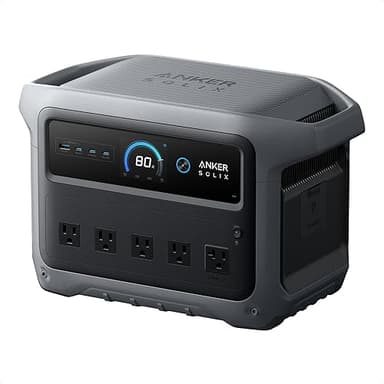
The Anker SOLIX C1000 Gen 2 is our fast-recharge 1kWh pick. With 1024Wh capacity, the model gives about 14.5 hours at 60W — 1.5 eight-hour nights after rounding down. Its 2000W output is well above the example loads here, but output headroom alone does not establish CPAP compatibility.
CPAP-specific runtime estimates:
- 40W CPAP (no humidifier): 21.8 hours = 2.5 nights
- 60W CPAP (moderate humidifier): 14.5 hours = 1.5 nights
- 90W CPAP (heated hose + humidifier): 9.7 hours = 1 night
The 49-minute recharge time is the fastest in this category. If you're car camping, you can top up from your vehicle during a day hike. The 600W solar input means you can fully recharge with two 300W panels in 2-3 hours of good sun.
At 24.9 lbs, it's portable but not light. You won't want to backpack with it, but it's manageable for car camping, RV use, or storing in a bedroom closet for power outages.
The manufacturer rates its LiFePO4 battery for 4,000 cycles to 80% capacity. A cycle rating is not a calendar-life or stored-backup reliability guarantee.
Pros
- Estimated 1.5 nights at 60W; 2.5 at 40W
- Fastest recharge time (49 minutes)
- 4,000-cycle lifespan
- 6 AC outlets for CPAP + other devices
Cons
- About 25 lbs — not ultralight
- More capacity than one-night users need
Best for: Weekend campers, van lifers, and emergency preparedness. If you want one station that handles CPAP plus other camping gear (fans, electric coolers, lights), this is it.
Don't buy if you only need occasional single-night backup and want the absolute lightest option — see the Jackery below.
EcoFlow Delta 3 — Best for Versatility
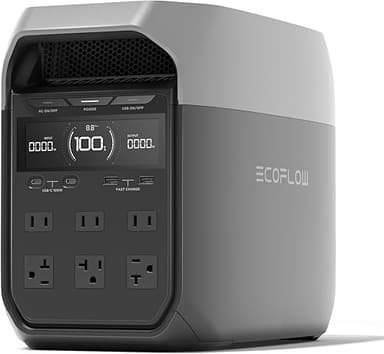
The EcoFlow Delta 3 (last checked $629.00 · checked Oct 19, 2026 · see on Amazon) replaced the Delta 2 (whose Amazon listings now redirect to it) and keeps the same 1024Wh capacity and 1800W output, now with 3600W surge in a 27.6-lb package. It matches the Anker C1000 Gen 2 in capacity and typically trades the price lead with it sale to sale — check both before buying.
CPAP-specific runtime estimates:
- 40W CPAP (no humidifier): 21.8 hours = 2.5 nights
- 60W CPAP (moderate humidifier): 14.5 hours = 1.5 nights
- 90W CPAP (full heating): 9.7 hours = 1 night
The battery is rated for 4,000 cycles to 80% capacity, up from the Delta 2's 3,000, and the 56-minute AC recharge is within a few minutes of Anker's 49. The 500W solar input accepts most portable panel setups: at our 0.65 planning multiplier, a matched 500W array refills it in about 3.2 hours of full sun. EcoFlow also lists a UPS switchover under 10ms and an expansion path with add-on batteries; confirm which expansion pieces you would need before planning around it.
Pros
- 4,000-cycle battery, matching the Anker and Jackery
- 56-minute AC recharge
- 3,600W surge for fridge compressors and other motor loads
- Expandable with EcoFlow add-on batteries
Cons
- 27.6 lbs — about 4 lbs heavier than the Jackery 1000 v2
- 500W solar input trails the C1000 Gen 2's 600W
- Newer platform with a shorter public track record
Best for: Buyers who want 1800W of headroom and 500W of solar input in one 1kWh station. Also great for van lifers who need versatility — one station handles CPAP, cooking appliances, and power tools.
Don't buy if you primarily camp off-grid for multi-day trips — 1024Wh isn't enough for 3+ nights without solar recharge.
Jackery Explorer 1000 v2 — Lighter 1kWh Pick
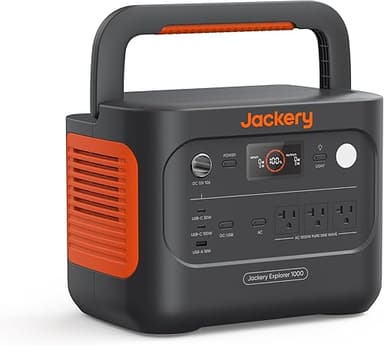
The Jackery Explorer 1000 v2 is rated for 1070Wh and 1500W output at 23.8 lbs, lighter than the Anker and Delta 3 picks here. Its 4,000-cycle battery rating matches those two picks; it does not establish a decade of usable life.
CPAP-specific runtime estimates:
- 40W CPAP (no humidifier): 22.7 hours = 2.5 nights
- 60W CPAP (moderate humidifier): 15.2 hours = 1.5 nights
- 90W CPAP (full heating): 10.1 hours = 1 night
Jackery redesigned the Explorer 1000 for 2025-2026 with faster charging (60 minutes vs. 90+ on the v1) and increased cycle life. The brand has strong retail presence — you can often find it at Costco or Target, making returns and warranty claims simpler than online-only brands.
The 400W solar input is adequate but not industry-leading. With two 200W panels, expect 3-4 hours to full charge in optimal conditions.
Pros
- Lightest in the 1000Wh category at 23.8 lbs
- 4000 cycle lifespan
- Retail availability for easy returns
- Clean, minimal design
Cons
- Lower output (1500W vs 2000W on competitors)
- Less solar input than Anker
- Fewer USB ports than competitors
Best for: Buyers who want similar modeled CPAP runtime to the Anker in a lighter package. Compare the dated offers and maintain the battery according to the manual; storage does not guarantee readiness years later.
Don't buy if you need to power high-wattage AC appliances — the 1500W output is lower than competitors.
EcoFlow Delta 2 Max — Best for Extended Trips
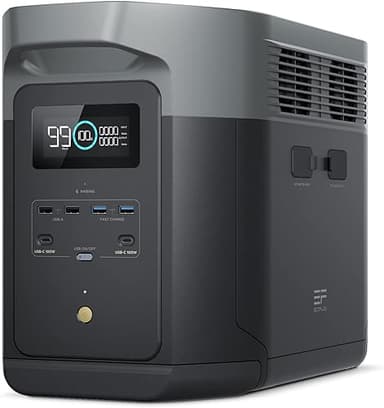
The EcoFlow Delta 2 Max (last checked $1049.00 · checked Oct 19, 2026 · see on Amazon) is the pick for more nights between charges. Its 2,048Wh gives about 1,741Wh usable under our AC model, or 29 hours at 60W — 3.5 eight-hour nights. It replaced the Explorer 2000 Plus in this guide after our recorded Amazon offer became unavailable. Retailer availability changes; the dated offer above is separate from that editorial history.
CPAP-specific runtime estimates:
- 40W planning example: 43.5 hours = 5 nights
- 60W planning example: 29.0 hours = 3.5 nights
- 90W planning example: 19.3 hours = 2 nights
The 2,400W output (3,100W surge) handles multiple devices at once — run your CPAP, charge laptops, and power a portable fridge. It's also expandable: EcoFlow rates it for up to 6kWh with two add-on batteries, so it can start as a camping station and grow into outage backup later. AC recharge is rated at 81 minutes.
At 50 lbs it is light for a 2kWh station, but it's still built for RVs, basecamp camping, or home backup — not carrying down a trail. The trade-offs against the 2000 Plus it replaces are a 3,000-cycle battery (against 4,000) and less surge headroom for motor loads.
Pros
- 3.5 nights at 60W
- Expandable to 6kWh with EcoFlow add-on batteries
- 81-minute AC recharge
- 50 lbs — light for a 2kWh station
Cons
- 3,000-cycle battery, below the 4,000 of the 1kWh picks above
- 3,100W surge, about the same as the 1kWh Anker C1000 Gen 2
- 50 lbs is still a two-hand carry
Best for: Van lifers, full-time RVers, and emergency preppers. If you need to support a family during multi-day outages or hate planning trips around recharge opportunities, the capacity justifies the weight and cost.
Don't buy if your camping is mostly weekend trips — you'll never use the capacity, and the weight is a liability.
Best Panel-Included Bundle for CPAP: EcoFlow River 2 Pro Solar Generator
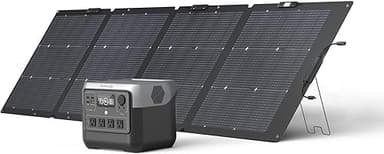
EcoFlow · RIVER 2 Pro + 220W
768 Wh · 800W output · 220W panel
For single-night backup with a solar panel included, the EcoFlow River 2 Pro Solar Generator (last checked $719.00 · checked Oct 19, 2026 · see on Amazon) pairs a smaller station with a 220W panel. Compare its total price with other station-and-panel bundles; a standalone station may cost less. The 768Wh capacity yields roughly 650Wh usable after inverter loss — about one night at 60W, or two nights at 40W. Unlike the stations above, it ships as a bundle with its own 220W solar panel, which can replace a humidifier-off night in a few hours of good sun.
CPAP-specific runtime estimates:
- 40W CPAP (no humidifier): 16.3 hours = 2 nights
- 60W CPAP (moderate humidifier): 10.8 hours = 1 night
- 90W CPAP (heated hose + humidifier): 7.3 hours — short of one 8-hour night
The 800W pure sine wave output is far more than any CPAP needs, and LiFePO4 chemistry gives it the same long cycle life as the bigger stations.
Pros
- 220W panel included in the bundle price
- Estimated 2 nights at 40W on AC
- Estimated 1 night at 60W on AC
- LiFePO4 chemistry for long cycle life
Cons
- 768Wh can't cover two humidified nights without recharging
- 800W output rules out running high-draw appliances alongside the CPAP
Best for: Single-night backup, weekend campers who run the humidifier off, and anyone who wants the panel included rather than sized and bought separately.
Don't buy if your measured draw approaches 90W for eight hours: that is 720Wh at the CPAP, beyond this station's estimated 653Wh usable on AC. Compare the 1kWh class or larger and add a reserve.
Comparison Table
| Spec | Anker SOLIX C1000 Gen 2 | EcoFlow Delta 2 Max | Jackery Explorer 1000 v2 | EcoFlow River 2 Pro Solar Generator (220W) | EcoFlow DELTA 3 Portable Power Station |
|---|---|---|---|---|---|
| Capacity | 1024 Wh | 2048 Wh | 1070 Wh | 768 Wh | 1024 Wh |
| Continuous Output | 2000 W | 2400 W | 1500 W | 800 W | 1800 W |
| Surge Output | 3000 W | 3100 W | 3000 W | 1600 W | 3600 W |
| Weight | 24.9 lbs | 50 lbs | 23.8 lbs | — | 27.6 lbs |
| Battery Chemistry | LiFePO4 | LiFePO4 | LiFePO4 | LiFePO4 | LiFePO4 |
| Cycle Life | 4000 cycles | 3000 cycles | 4000 cycles | — | 4000 cycles |
| Recharge Time | 49 min | 81 min | 60 min | — | 56 min |
| Max Solar Input | 600 W | 1000 W | 400 W | — | 500 W |
| Included Panel | — | — | — | 220 W | — |
| Outlets | 6 AC · 1 Car · 2 USB-A · 2 USB-C | — | — | — | — |
Down to two 1,000Wh finalists? The head-to-heads work through runtime, recharge, and switchover spec by spec: C1000 Gen 2 vs Jackery 1000 v2 and Delta 3 vs Jackery 1000 v2. The older C1000 Gen 2 vs Delta 2 and Delta 2 vs Jackery 1000 v2 pages are kept for reference; the Delta 3 replaced the Delta 2 in this guide after its recorded Amazon offer lapsed.
How to Extend CPAP Battery Runtime
Size for your usual prescribed therapy. Do not change pressure settings to make a battery last longer. Ask your care team before changing humidification or heated-tube use; the calculator's 40W, 60W, and 90W cases are planning examples, not instructions to alter treatment.
Measure the whole setup: Use your usual accessories and a representative night's energy consumption. Include other devices you intend to run from the station.
Check a compatible DC option: A manufacturer-supported converter may reduce losses by bypassing the AC inverter, but still has conversion losses. Match the exact device, voltage, connector, and station-port limits. Our calculator models AC only.
Recharge when power is available: Compare the watt-hours used each night with what your charging setup can actually replace. Solar input and car charging can be much slower than AC charging; a few hours does not guarantee another night.
Follow operating and storage limits: Keep the station dry, ventilated, and within the manufacturer's temperature limits. Do not cover it with bedding or block cooling openings.
Frequently Asked Questions
What is the best battery backup for a CPAP during a power outage?
Choose the required nights and connection first. For two eight-hour nights at 60W, the AC model needs at least 1,130Wh rated capacity before a separate reserve; the 2,048Wh Delta 2 Max calculates to 3.5 nights. The 1kWh picks calculate to 1.5 nights at 60W. If automatic switching matters, confirm support for your exact CPAP and backup arrangement with the manufacturers or equipment provider. An advertised UPS/EPS transfer time does not guarantee uninterrupted CPAP operation. See the outage section.
What is the best CPAP battery for camping?
Compare carried weight, measured nightly energy, and opportunities to recharge. The 768Wh River 2 Pro bundle calculates to 2 eight-hour nights at 40W, 1 at 60W, or 0.5 at 90W on AC. The Anker C1000 Gen 2 and Jackery 1000 v2 calculate to 1.5 nights at 60W; for two nights without charging, choose more capacity and a reserve. A panel bundle can help when conditions permit, but do not assume a daily refill. Dedicated CPAP batteries may suit lighter travel when the manufacturer supports your device and required runtime.
Can I use my CPAP without power?
No. CPAP machines require continuous power to maintain pressure. Unlike manual respirators, there's no fallback mechanism. If you rely on CPAP therapy, backup power should be treated as essential gear when sleeping away from reliable grid power.
How long will a power station run my CPAP?
For a 60W CPAP running 8 hours (480Wh a night): a 500Wh station doesn't quite cover one full night, 1000Wh gives about one and a half, and 2000Wh gives three and a half. Use the formula: (station Wh × 0.85) ÷ (CPAP watts × hours), and round down — a night you finish at 80% is not a night. The 0.85 accounts for inverter efficiency loss. Measure your actual CPAP wattage with a Kill-A-Watt meter for precise calculations.
Do I need a pure sine wave inverter for CPAP?
Follow the requirements for your exact CPAP and power supply. The stations here advertise pure sine wave AC output, but that specification alone does not establish device compatibility, runtime, or uninterrupted operation. Ask the manufacturer or equipment provider about the intended setup.
Can I recharge a power station with solar while using it for CPAP?
Check the exact station's manual for simultaneous input/output limits and the CPAP manufacturer's connection requirements. Solar recharge depends on daylight, conditions, and input limits; it may not replace a night's consumption each day. Plan battery capacity for periods when recharging is unavailable.
Are power stations safe for medical devices like CPAP?
Compatibility needs to be confirmed for the exact device, power supply or converter, and backup arrangement. These runtime calculations do not establish medical-device suitability or uninterrupted operation. Follow both manufacturers' instructions and discuss your outage plan with your equipment provider. Keep the station dry and ventilated.
Should I buy a travel CPAP for camping instead?
Discuss a travel device with your care team if size and weight are important. Compare the manufacturer's energy and accessory requirements at your prescribed settings, along with the cost of a compatible battery. A different CPAP is a treatment-equipment decision; buying a power station alone does not establish compatibility with your existing machine.
Where can I find my CPAP's wattage rating?
Start with the device manual. The power supply's voltage multiplied by rated current gives its output rating, not your CPAP's average draw. For runtime planning, measure watt-hours over a representative night with your usual prescribed settings, humidifier, and heated tube, then divide by the hours used. See wattage by model.
Can I use a power station in the rain while camping?
No — the stations in this guide are not waterproof. Keep them inside your tent, vehicle, or under a rain fly. Never run AC outlets in wet conditions — output terminals aren't weatherproof even when a housing is splash-resistant. Use the power station in a dry location and run extension cords outside if needed.
Which Jackery is best for CPAP use?
The Explorer 1000 v2 is the lighter 1kWh pick in this guide. Its 1,070Wh calculates to 1.5 eight-hour nights at 60W or 2.5 at 40W on AC. For two or more nights at 60W without charging, compare larger stations such as the Delta 2 Max, which calculates to 3.5 nights. Check the dated offer and exact CPAP connection before choosing; brand preference does not change the capacity requirement.
What's the quietest power station for CPAP backup?
We have not measured noise at CPAP loads and cannot rank these stations by bedside noise. Fans may run during charging or use depending on load and temperature. Check model-specific documentation and independent measurements rather than assuming a low load or DC connection means silent operation.
Final Recommendations
For a fast-recharge 1kWh option, compare the Anker SOLIX C1000 Gen 2. It calculates to 1.5 eight-hour nights at 60W or 2.5 at 40W. Match that estimate to the outage length you are planning for and allow a reserve.
For a lighter 1kWh station, the Jackery Explorer 1000 v2 offers similar calculated runtime at 23.8 lbs. Compare the dated retailer offers; its 4,000-cycle rating does not establish calendar life or current stock.
Van lifers and extended-trip adventurers need the EcoFlow Delta 2 Max. At 50 lbs it's a two-hand carry, but 3.5 nights at 60W — expandable to 6kWh with add-on batteries — means you're not planning your itinerary around charging opportunities.
If you want EcoFlow's app and flexibility for non-CPAP loads, the EcoFlow Delta 3 matches the leaders on runtime and adds 3,600W surge, a 4,000-cycle battery, and a capacity-expansion path.
For a panel-included setup, the EcoFlow River 2 Pro Solar Generator covers about one night at 60W and includes its own 220W panel. Compare its bundle price with a standalone station plus a compatible panel.
Whatever you choose, size for 20% more capacity than your calculations suggest. Your sleep health isn't worth cutting corners.
Previous Updates
Updated June 2026: two of our original picks (Bluetti AC60P and Anker SOLIX F2600) have been discontinued at major retailers, so we've replaced them with currently available recommendations. Updated August 2026: added a budget pick — the EcoFlow River 2 Pro Solar Generator — for single-night and humidifier-off users. Updated September 2026: retitled around "CPAP battery backup," the phrase most readers actually search, and added the dedicated-CPAP-battery vs power-station section plus outage and camping FAQs. Corrected September 23, 2026: several night counts (for example "nearly two nights" at 60W on a 1000Wh station) didn't follow our own published rule of rounding runtime down to the nearest half night; every per-wattage night count now rounds down to the half night (so 1.8 nights reads 1.5). Updated October 2026: the EcoFlow Delta 2 is no longer sold at Amazon (its listings now serve the Delta 3), so our versatility pick is now the Delta 3. The same day, our extended-trips pick changed from the Jackery Explorer 2000 Plus, which Amazon lists as currently unavailable, to the EcoFlow Delta 2 Max.