
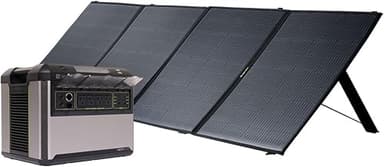
Our Review
The station Goal Zero needed to build — 1,505Wh of 4,000-cycle LiFePO4, 2,000W output, and a 1.1-hour recharge. Worth the price if you're staying in the ecosystem; rivals give you more capacity per dollar if you aren't.
Specifications
| Capacity | 1505 Wh |
|---|---|
| Continuous output | 2000 W |
| Surge output | 3600 W |
| Battery chemistry | LiFePO4 |
| Cycle life (to 80%) | 4000 cycles |
| AC recharge | 66 min |
| Max solar input | 900 W |
| Weight | 52.75 lbs |
Rating corrected October 11, 2026: 3.9 → 4.2. The earlier score predated our published value anchors, which need a dated street price; our October 11 Amazon check found it in stock at $1,499.95. Scored against the rubric, with the ecosystem-expansion adjustment for Goal Zero's Tank and Home Integration Kit. The factor math is on our ratings page.
The new Yeti 1500 keeps the name, the 2,000W output, and the accessory ecosystem of the Yeti 1500X, and replaces the component that was costing Goal Zero recommendations: the battery.
1,505Wh of LiFePO4, rated for 4,000 cycles to 80%. The 1500X was rated for 500. That takes the platform's rated lifetime energy from roughly 758kWh to about 6,020kWh — from the weakest figure we list to the same tier as the Jackery Explorer 2000 Plus (no recently verified in-stock offer), also rated at 4,000 cycles. Cycle life is the spec that decides whether a station lasts three years or twelve (LiFePO4 vs NMC).
Charging moved from the platform's weakest point to a genuine strength. Goal Zero rates wall recharge at 1.1 hours to full and 0.8 hours to 80%, against the 1500X's 14 hours on its included 120W supply — or about 3 hours if you bought the 1500X's optional 600W supply. Solar input rises to 900W across dual ports, a ratio of 0.60W per Wh of capacity, ahead of the Bluetti Elite 200 V2 (no recently verified in-stock offer) at 0.48 and trailing the Explorer 2000 Plus at 0.69. Real-world harvest still runs below any panel's sticker rating (why).
Output is 2,000W continuous with a 3,600W surge across four AC outlets, up from two on the 1500X. That starts a full-size fridge or a microwave — check your appliance's startup draw against Surge Watts vs Running Watts first. On the USB side Goal Zero publishes a 140W USB-C port plus a 60W and two 30W, for 260W combined; the 1500X offered a single 60W port.
Two things hold the score down. At 52.75 lbs it's heavier than the 1,516Wh unit it replaces. And at $1,499.95 (its Amazon price on our October 11, 2026 check, the same as Goal Zero's list) the capability-per-dollar math doesn't favour it: about 4.0kWh of rated lifetime energy per dollar, against ~13.8 for the Bluetti Elite 200 V2, which also gives you 2,073.6Wh and a 6,000-cycle pack for less money. The premium buys the ecosystem — Home Integration Kit, Yeti Tank, Boulder panels — and that is a real thing to buy, but only if you'll use it.
Pros
- 4,000-cycle LiFePO4 — about 6,020kWh of rated lifetime energy
- 1.1-hour wall recharge, per Goal Zero's rating
- 900W solar input across dual ports
- 140W USB-C; 260W combined USB-C output
- Four AC outlets, up from two on the 1500X
- Home Integration Kit and Boulder panel compatibility
Cons
- 52.75 lbs — heavier than the 1500X it replaces
- About 4.0kWh lifetime per dollar vs ~13.8 for the Bluetti Elite 200 V2
- The premium is largely for the Goal Zero ecosystem
What it actually runs
A full 1,505Wh charge yields about 1,280Wh usable after inverter loss:
| Device | Typical draw | Runtime per charge |
|---|---|---|
| CPAP (humidifier on) | 60W | ~21 hours (2.5 nights) |
| CPAP (humidifier off) | 30W | ~42 hours (5 nights) |
| Full-size fridge | ~65W avg | ~19 hours |
| Laptop | 50W | ~25 hours |
| 65″ LED TV | 100W | ~12 hours |
| Camp lights + phones | ~25W | ~51 hours |
What's the difference between the Yeti 1500 and the Yeti 1500X?
Same name, different battery. The 1500X used Li-ion NMC rated for 500 cycles; the new Yeti 1500 uses LiFePO4 rated for 4,000. Wall recharge drops from about 14 hours to 1.1, solar input rises from 600W to 900W, AC outlets go from two to four, and USB-C from 60W to 140W. Capacity and continuous output are effectively unchanged.
Is the Goal Zero Yeti 1500 worth the price?
It depends whether you'll use the ecosystem. On raw specs the Bluetti Elite 200 V2 gives you 2,073.6Wh and a 6,000-cycle pack for less — about 13.8kWh of rated lifetime energy per dollar against the Yeti's 4.0. What Goal Zero offers that rivals don't package the same way is the Home Integration Kit for transfer-switch backup, Yeti Tank expansion batteries, and Boulder panel compatibility. If that path matters to you the premium is defensible; if not, you're paying for it anyway.
How long does the Goal Zero Yeti 1500 take to charge?
Goal Zero rates it at about 1.1 hours to full from a wall outlet and 0.8 hours to 80%. Solar input tops out at 900W across two ports, though real-world panel output typically runs 65–80% of the rated wattage.
How many cycles does the Yeti 1500 battery last?
It's rated for 4,000 cycles to 80% capacity at 25°C. At one full cycle per day that's roughly eleven years before you'd expect 80% of the original 1,505Wh — matching the Jackery Explorer 2000 Plus, though the Bluetti Elite 200 V2's 6,000-cycle pack outlasts both.
Who it's for: Goal Zero owners with Boulder panels, a Yeti Tank, or a Home Integration Kit already installed — this is the first station in the lineup where staying in the ecosystem no longer costs you battery lifespan. If you're starting from nothing, price it against the Jackery Explorer 2000 Plus (no recently verified in-stock offer), which offers more capacity and the same 4,000-cycle rating for comparable money.