
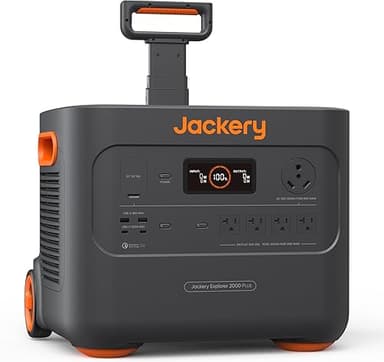
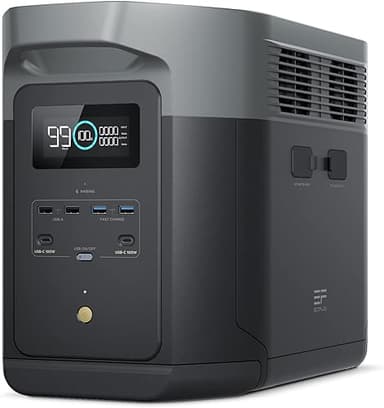
Two ~2,048Wh stations for extended trips and home backup, with a clear split between capability and portability.
The Jackery is the stronger off-grid machine. 3,000W output (6,000W surge) runs heavier appliances than the Delta 2 Max's 2,400W (3,100W surge), and its 1,400W solar input dramatically out-charges the EcoFlow's 1,000W — meaningful if you're refilling 2kWh from panels daily (why solar throughput matters). Its 4,000-cycle battery also beats the EcoFlow's 3,000 for lifespan (LiFePO4 vs NMC).
The EcoFlow is the more livable one. At 50 lbs it's over 11 lbs lighter than the Jackery's 61.7 — a real difference when you're loading it in and out of a vehicle — and EcoFlow's app remains the best in the category for monitoring and control.
Explorer 2000 Plus vs Delta 2 Max: the spec sheet side by side
Every figure below is the manufacturer's rating. Where a number is our arithmetic, the formula is stated underneath.
| Spec | Jackery Explorer 2000 Plus | EcoFlow Delta 2 Max | Edge |
|---|---|---|---|
| Rated capacity | 2,042Wh | 2,048Wh | Tie |
| Usable capacity (× 0.85) | ~1,735Wh | ~1,740Wh | Tie |
| Running watts | 3,000W | 2,400W | Jackery |
| Surge watts | 6,000W | 3,100W | Jackery |
| Battery chemistry | LiFePO4 | LiFePO4 | Tie |
| Rated cycle life | 4,000 cycles | 3,000 cycles | Jackery |
| AC recharge to full (rated) | 120 minutes | 81 minutes | EcoFlow |
| Max solar input | 1,400W | 1,000W | Jackery |
| Advertised UPS switchover | 20ms | Not stated (Delta 2-series figure: 30ms) | Jackery |
| Expandable battery | Yes, to 24kWh | Yes, add-on batteries | Both |
| Weight | 61.7 lbs (wheeled) | 50 lbs | EcoFlow |
Usable Wh = rated Wh × 0.85 (inverter loss, applied once — how we calculate runtime).
The two batteries are the same size, so runtime is a tie. The Jackery wins most of the power rows: running watts, surge watts, cycle life, and solar intake. The EcoFlow wins on wall-charging time and weight.
What each one actually runs
Runtime = usable Wh ÷ device watts, with device draw used as-is. Nights are rounded down to the half night.
| Load | Typical draw | Jackery 2000 Plus (~1,735Wh) | EcoFlow Delta 2 Max (~1,740Wh) |
|---|---|---|---|
| CPAP, humidifier on | 60W | ~29 hours (3.5 nights at 8 hrs) | ~29 hours (3.5 nights at 8 hrs) |
| Full-size fridge (cycling) | ~65W avg | ~27 hours | ~27 hours |
| Space heater | 1,500W | ~1.1 hours | ~1.1 hours |
Where the two part ways is surge. The Jackery's 6,000W surge rating is nearly double the Delta 2 Max's 3,100W. That headroom decides whether a well pump, a large chest freezer, or a window AC starts at all. Check your own motor loads with the surge sizer, and see why the starting spike matters in Surge Watts vs Running Watts.
Recharge: wall vs solar
On AC, the Delta 2 Max's rated 81 minutes beats the Jackery's 120.
On solar, the Jackery leads by a wide margin. At our planning multiplier — real solar watts = rated panel watts × 0.65 — an array sized to each unit's maximum input gives:
- Jackery 2000 Plus: 2,042Wh ÷ (1,400W × 0.65) ≈ 2.2 hours of full sun
- Delta 2 Max: 2,048Wh ÷ (1,000W × 0.65) ≈ 3.2 hours of full sun
Filling 1,400W of input takes about seven 200W panels. Few campers carry that many, but a fixed home or RV roof array can. If you'll run on solar for days, the Jackery's intake is the spec that matters most. Model your own array in the solar recharge calculator.
As a UPS for home backup
Jackery states a 20ms switchover for the 2000 Plus. EcoFlow doesn't state one for the Delta 2 Max on its product page; the Delta 2-series figure is 30ms. Most desktop PC power supplies bridge only 16–20ms, so a desktop may reboot on either one. Routers, modems, laptops, and CPAPs generally ride through the gap. The full model-by-model table is in Can a Power Station Replace a UPS?.
FAQ
Is the Jackery Explorer 2000 Plus better than the EcoFlow Delta 2 Max?
On power, yes. It has 600W more running output, nearly double the surge rating, 400W more solar input, and a longer-rated battery (4,000 vs 3,000 cycles). The Delta 2 Max is 11.7 lbs lighter, recharges faster from the wall, and has the better app.
How many nights will each run a CPAP?
About 3.5 nights at 60W for 8 hours a night on either one. Both hold roughly 1,740Wh usable. Model-by-model sizing is in our CPAP battery backup guide.
Which one can start a well pump or window AC?
The Jackery is the safer bet. Its 6,000W surge rating gives far more room for a motor's startup spike than the Delta 2 Max's 3,100W. Check the appliance's locked-rotor or starting-watt figure against each station's surge rating before you count on either.
Can both be expanded with extra batteries?
Yes. Jackery rates the 2000 Plus as expandable to 24kWh with add-on batteries, and the Delta 2 Max also accepts EcoFlow add-on batteries.
Who should buy which
Best for off-grid and home backup: Jackery Explorer 2000 Plus (no recently verified in-stock offer). More running output, far more surge headroom for motors, 1,400W of solar intake, and a battery rated for 4,000 cycles. Don't buy it if you'll lift it in and out of a vehicle often; at 61.7 lbs it's built to be wheeled.
Best for a lighter 2kWh station: EcoFlow Delta 2 Max (last checked $1049.00 · checked Oct 19, 2026 · see on Amazon). Eleven pounds lighter, faster to refill from the wall, and the best app in the category. Don't buy it if you need to start large motor loads, or you'll recharge mostly from a big solar array.
Weighing a third 2kWh option? See Bluetti Elite 200 V2 vs EcoFlow Delta 2 Max.