
Best Portable Power Station for CPAP Machines (2026)
Updated June 2026: two of our original picks (Bluetti AC60P and Anker SOLIX F2600) have been discontinued at major retailers, so we've replaced them with currently available recommendations.
If you have sleep apnea, your CPAP machine isn't optional. Whether you're camping in the backcountry, living in a van, or preparing for power outages, you need reliable backup power. Losing CPAP access means poor sleep, daytime fatigue, and real health risks. A portable power station solves this — no generators, no noise, just dependable overnight power wherever you need it.
The challenge: CPAPs vary wildly in power consumption. A modern travel CPAP might use 30W. An older machine with heated humidifier and hose can pull 90W or more. Size your power station wrong, and your CPAP may shut off before morning.
This guide breaks down the math, provides real runtime estimates, and recommends the best power stations for CPAP users in 2026.
How We Picked
We calculated runtime from each power station's rated capacity multiplied by 85% inverter efficiency, then compared estimates against three common CPAP draw scenarios: 40W (no humidification), 60W (light humidifier), and 90W (heated hose plus humidifier).
We prioritized:
- LiFePO4 chemistry — longer cycle life and better thermal stability than older lithium-ion
- Pure sine wave AC output — required for safe CPAP operation
- Practical overnight capacity — at least one full 8-hour night for typical CPAP use
- Quiet operation — no fans audible from a tent or bedside
- Solar input compatibility — for multi-day off-grid use
- Manufacturer warranty and support — affiliate convenience matters less than long-term reliability
We did not perform hands-on testing of the units in this guide. Runtime numbers are calculated from manufacturer-published specs and a standard 0.85 inverter efficiency factor, not measured in the field. Real-world runtime varies based on temperature, battery age, and exact CPAP power draw.
Quick Picks
How to Size a Power Station for Your CPAP
CPAP power consumption varies based on three factors: pressure setting, humidifier use, and whether you use a heated hose. Most CPAPs run between 30-90W.
The sizing formula:
(CPAP watts × hours of use) ÷ 0.85 = minimum Wh capacity
The 0.85 accounts for inverter efficiency loss — power stations convert DC battery power to AC, losing about 15% in the process.
Runtime Examples by CPAP Wattage
| CPAP Power | 8 Hours (1 Night) | 16 Hours (2 Nights) | Recommended Minimum |
|---|---|---|---|
| 40W (no humidifier) | 376 Wh | 752 Wh | 500 Wh station |
| 60W (light humidifier) | 565 Wh | 1,129 Wh | 1,000 Wh station |
| 90W (heated hose + humidifier) | 847 Wh | 1,694 Wh | 1,500+ Wh station |
Finding your CPAP's wattage:
- Check the power brick label — look for "Output" specs (usually 12V × amps)
- Multiply voltage by amperage (e.g., 12V × 5A = 60W)
- Run your CPAP on a Kill-A-Watt meter for actual consumption
- Add 20-40W if using heated humidifier or hose
Many full-size CPAPs ship with 65W to 90W power supplies, but actual overnight draw is often lower. Without heated humidification or tubing, expect 30-60W. With heating enabled, expect 60-100W. The only way to know your machine precisely is to measure it with a Kill-A-Watt meter.
Safety Margin
Always add 20% buffer capacity. If calculations show 565 Wh needed, buy a 700+ Wh station. This accounts for:
- Battery degradation over time
- Cold weather capacity reduction (10-20% loss below 40°F)
- Running other devices (phone charging, lights)
- Manufacturer capacity ratings measured under ideal conditions
Top Picks: Detailed Reviews
Anker SOLIX C1000 Gen 2 — Best Overall
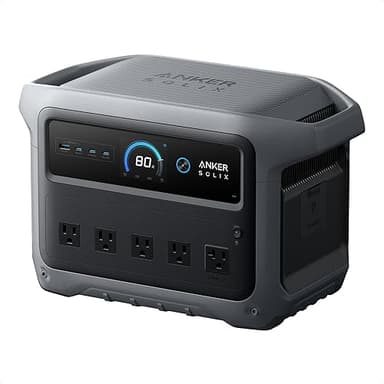
The Anker SOLIX C1000 Gen 2 hits the sweet spot for CPAP users. With 1024Wh capacity, it runs a 60W CPAP for about 14 hours — nearly two full nights with room to spare. The 2000W output handles any CPAP model, including older high-wattage units with heated everything.
CPAP-specific runtime estimates:
- 40W CPAP (no humidifier): 21.7 hours = 2.7 nights
- 60W CPAP (moderate humidifier): 14.5 hours = 1.8 nights
- 90W CPAP (heated hose + humidifier): 9.7 hours = 1.2 nights
The 49-minute recharge time is the fastest in this category. If you're car camping, you can top up from your vehicle during a day hike. The 600W solar input means you can fully recharge with two 300W panels in 2-3 hours of good sun.
At 24.9 lbs, it's portable but not light. You won't want to backpack with it, but it's manageable for car camping, RV use, or storing in a bedroom closet for power outages.
LiFePO4 chemistry provides 4,000 cycles to over 80% capacity. If you use it 50 nights per year, the battery will outlast multiple CPAP machines.
Pros
- Two-night capacity for most users
- Fastest recharge time (49 minutes)
- 4,000-cycle lifespan
- 6 AC outlets for CPAP + other devices
Cons
- About 25 lbs — not ultralight
- More capacity than one-night users need
Best for: Weekend campers, van lifers, and emergency preparedness. If you want one station that handles CPAP plus other camping gear (fans, electric coolers, lights), this is it.
Don't buy if you only need occasional single-night backup and want the absolute lightest option — see the Jackery below.
EcoFlow Delta 2 — Best for Versatility
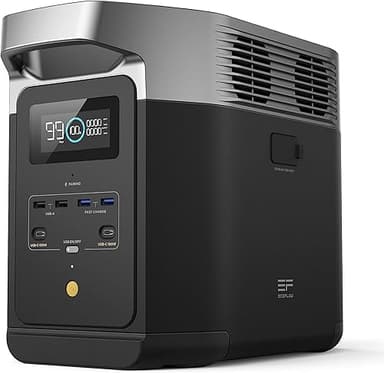
The EcoFlow Delta 2 (currently $449.00) offers 1024Wh capacity and 1800W output in a 27-lb package. It matches the Anker C1000 Gen 2 in capacity and typically trades the price lead with it sale to sale — check both before buying.
CPAP-specific runtime estimates:
- 40W CPAP (no humidifier): 21 hours = 2.6 nights
- 60W CPAP (moderate humidifier): 14 hours = 1.75 nights
- 90W CPAP (full heating): 9.5 hours = 1.2 nights
The X-Boost technology lets you run devices up to 2200W by reducing voltage — useful if you want to run a coffee maker or portable fridge alongside your CPAP during extended camping trips.
EcoFlow's app is the best in the category. You can monitor real-time power draw (useful for figuring out your actual CPAP consumption), set AC outlet timers, and control charging speed remotely.
The 80-minute recharge is slower than Anker's 49 minutes but still fast. The 500W solar input accepts most portable panel setups. Two 200W panels get you to full in 2.5-3 hours.
Pros
- Excellent app with granular controls
- X-Boost for high-wattage devices
- Expandable with extra batteries (up to 3kWh)
- Strong warranty support
Cons
- Slower AC recharge than Anker
- Lower solar input than C1000 Gen 2
- Fan noise under heavy load (not an issue with CPAP use)
Best for: Tech-focused users who want app control and data logging. Also great for van lifers who need versatility — the X-Boost feature means one station handles CPAP, cooking appliances, and power tools.
Don't buy if you primarily camp off-grid for multi-day trips — 1024Wh isn't enough for 3+ nights without solar recharge.
Jackery Explorer 1000 v2 — Best Long-Term Value
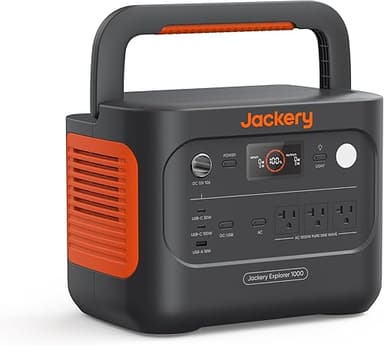
The Jackery Explorer 1000 v2 delivers 1070Wh capacity with 1500W output in the lightest package at 23.8 lbs. The standout feature is 4000 cycles — 33% more than most competitors. Over a decade of regular use, this matters.
CPAP-specific runtime estimates:
- 40W CPAP (no humidifier): 22 hours = 2.75 nights
- 60W CPAP (moderate humidifier): 15 hours = 1.9 nights
- 90W CPAP (full heating): 10 hours = 1.25 nights
Jackery redesigned the Explorer 1000 for 2025-2026 with faster charging (60 minutes vs. 90+ on the v1) and increased cycle life. The brand has strong retail presence — you can often find it at Costco or Target, making returns and warranty claims simpler than online-only brands.
The 400W solar input is adequate but not industry-leading. With two 200W panels, expect 3-4 hours to full charge in optimal conditions.
Pros
- Lightest in the 1000Wh category at 23.8 lbs
- 4000 cycle lifespan
- Retail availability for easy returns
- Clean, minimal design
Cons
- Lower output (1500W vs 2000W on competitors)
- Less solar input than Anker
- Fewer USB ports than competitors
Best for: Users who prioritize longevity and want a buy-it-for-life solution. The 4000-cycle rating and retail availability make this ideal for emergency preparedness — buy it, store it in a closet, and know it'll work when you need it in 2035.
Don't buy if you need to power high-wattage AC appliances — the 1500W output is lower than competitors.
Jackery Explorer 2000 Plus — Best for Extended Trips
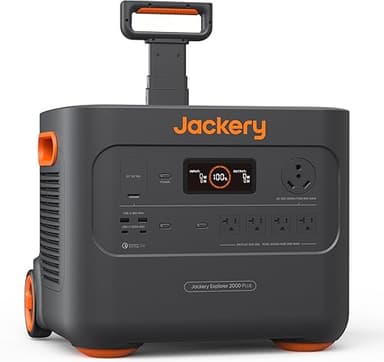
The Jackery Explorer 2000 Plus is the pick when one or two nights isn't enough. With 2042Wh capacity, it runs a 60W CPAP for roughly 29 hours — three to four full nights. If you're doing long camping trips, living in a van, or preparing for extended power outages, this capacity removes the nightly math.
CPAP-specific runtime estimates:
- 40W CPAP (no humidifier): 43 hours = 5.4 nights
- 60W CPAP (moderate humidifier): 29 hours = 3.6 nights
- 90W CPAP (full heating): 19 hours = 2.4 nights
The 3000W output handles multiple devices simultaneously — run your CPAP, charge laptops, and power a portable fridge with headroom to spare. It's also expandable: add battery packs to grow capacity (up to 24kWh in a fully built-out system), so it can start as a camping station and become whole-home backup later.
At around 61 lbs, this is semi-portable. The built-in wheels and pull handle help, but it's designed for RVs, basecamp camping, or home backup — not carrying down a trail.
Pros
- 3-4 nights for typical CPAP use
- Expandable capacity with add-on battery packs
- 3000W output for simultaneous devices
- LiFePO4 longevity with wheels for moving it
Cons
- Around 61 lbs — wheeled, but heavy
- Costs more than two single-night stations
- Overkill for occasional weekend camping
Best for: Van lifers, full-time RVers, and emergency preppers. If you need to support a family during multi-day outages or hate planning trips around recharge opportunities, the capacity justifies the weight and cost.
Don't buy if your camping is mostly weekend trips — you'll never use the capacity, and the weight is a liability.
Comparison Table
| Spec | Anker SOLIX C1000 Gen 2 | Jackery Explorer 1000 v2 | Jackery Explorer 2000 Plus | EcoFlow Delta 2 |
|---|---|---|---|---|
| Capacity | 1024 Wh | 1070 Wh | 2042 Wh | 1024 Wh |
| Continuous Output | 2000 W | 1500 W | 3000 W | 1800 W |
| Surge Output | 3000 W | 3000 W | 6000 W | 2700 W |
| Weight | 24.9 lbs | 23.8 lbs | 61.7 lbs | 27 lbs |
| Battery Chemistry | LiFePO4 | LiFePO4 | LiFePO4 | LiFePO4 |
| Cycle Life | 4000 cycles | 4000 cycles | 4000 cycles | 3000 cycles |
| Recharge Time | 49 min | 60 min | 120 min | 80 min |
| Max Solar Input | 600 W | 400 W | 1400 W | 500 W |
| Outlets | 6 AC · 1 Car · 2 USB-A · 2 USB-C | — | — | — |
How to Extend CPAP Battery Runtime
Most CPAP users can double their runtime with simple adjustments. These tips won't compromise therapy quality for most people, but always consult your sleep doctor before changing pressure settings.
Turn off heated humidifier: This single change saves 50-70% power consumption. A 90W CPAP drops to 30-40W without the humidifier. Use nasal saline spray before bed to prevent dryness.
Disable heated hose: If your machine has a heated tube, turn it off. This saves 10-15W. Combat rainout (condensation in the tube) by insulating your hose with foam pipe insulation or running it under blankets.
Lower pressure settings: If your doctor approves, reducing pressure by 1-2 cm H₂O can save 5-10W. Most users won't notice the difference, especially if your prescription has a range (e.g., APAP 8-12).
Use a travel CPAP: Modern travel machines like the ResMed AirMini or Transcend use 20-30W — half the power of full-size units. If you camp regularly, a dedicated travel CPAP pays for itself in battery capacity saved.
Charge during the day: If you're car camping or have solar panels, top up your power station while you're hiking or at the beach. Even 2-3 hours of charging adds a full night of CPAP runtime.
Keep batteries warm: Cold temperatures reduce lithium battery capacity by 10-20%. In winter camping, store your power station inside your sleeping bag or tent (not outside in your vehicle).
Use DC power if possible: Some CPAPs can run directly on 12V DC using an optional cable. This bypasses the AC inverter, saving 15% power loss. Check your CPAP manual for DC compatibility.
Frequently Asked Questions
Can I use my CPAP without power?
No. CPAP machines require continuous power to maintain pressure. Unlike manual respirators, there's no fallback mechanism. If you rely on CPAP therapy, backup power should be treated as essential gear when sleeping away from reliable grid power.
How long will a power station run my CPAP?
For a 60W CPAP running 8 hours: a 500Wh station gives 1 night, 1000Wh gives 2 nights, 2000Wh gives 4 nights. Use the formula: (station Wh × 0.85) ÷ (CPAP watts × hours). The 0.85 accounts for inverter efficiency loss. Measure your actual CPAP wattage with a Kill-A-Watt meter for precise calculations.
Do I need a pure sine wave inverter for CPAP?
Yes. CPAP motors require pure sine wave AC power. All power stations in this guide provide pure sine wave output — it's now standard in quality portable power stations. Modified sine wave inverters (common in cheap stations) can damage CPAP motors or cause erratic pressure.
Can I recharge a power station with solar while using it for CPAP?
Yes. All modern power stations support pass-through charging — you can charge via solar while running your CPAP simultaneously. During multi-day camping, set up solar panels during the day to fully recharge before night use. Even 4-5 hours of partial sun can replace the power used overnight.
Are power stations safe for medical devices like CPAP?
Yes, but verify pure sine wave output. Portable power stations are safer than generators — no voltage spikes, no exhaust fumes, no noise. LiFePO4 chemistry (used in all recommended models) is thermally stable and includes battery management systems to prevent overcharge or overheat. Keep the station dry and ventilated.
Should I buy a travel CPAP for camping instead?
If you camp regularly, yes. Travel CPAPs like the ResMed AirMini or Z2 Auto use 50-70% less power than full-size machines. You can run them on smaller, lighter power stations. However, they cost $500-900 and lack features like advanced humidification. A power station works with your existing CPAP and powers other devices too.
Where can I find my CPAP's wattage rating?
Check the power supply brick connected to your CPAP. Look for "Output" specs — usually listed as voltage (V) × amperage (A). Multiply these: 12V × 5A = 60W. For actual consumption including humidifier and hose heating, use a Kill-A-Watt meter ($20 on Amazon). Run your CPAP for 30 minutes with your typical settings and note the average wattage.
Can I use a power station in the rain while camping?
No — the stations in this guide are not waterproof. Keep them inside your tent, vehicle, or under a rain fly. Never run AC outlets in wet conditions — output terminals aren't weatherproof even when a housing is splash-resistant. Use the power station in a dry location and run extension cords outside if needed.
Final Recommendations
For most CPAP users, the Anker SOLIX C1000 Gen 2 delivers the best balance of capacity, weight, and features. Two nights of runtime eliminates anxiety, and the fast recharge means you can top up during day activities.
For long-term value, the Jackery Explorer 1000 v2 is the buy-it-for-life pick — nearly identical CPAP runtime to the Anker, the lightest weight in its class, a 4000-cycle battery, and retail availability that simplifies warranty claims.
Van lifers and extended-trip adventurers need the Jackery Explorer 2000 Plus. It's heavy, but 3-4 nights of capacity — expandable with extra battery packs — means you're not planning your itinerary around charging opportunities.
If you want the best app experience and flexibility for non-CPAP loads, the EcoFlow Delta 2 matches the leaders on runtime and adds X-Boost and capacity expansion.
Whatever you choose, size for 20% more capacity than your calculations suggest. Your sleep health isn't worth cutting corners.