
"Recharges from the sun" is doing a lot of work in that marketing copy. Three numbers decide whether you refill your power station in a day or spend the week watching your battery drain faster than it charges: your daily watt-hour draw, the panel's real-world output, and how many usable sun hours your location actually delivers. The math is straightforward once you plug in honest numbers. Here's how to size a solar setup that keeps pace with your gear — not one that leaves you rationing phone charges by Wednesday.
Number One: Your Daily Watt-Hour Draw
Start with what you actually consume in 24 hours, not the station's capacity. Add up every device:
- Compressor fridge: 600–800 Wh per day (cycling on/off)
- CPAP, humidifier off: 240–320 Wh per night (30–40W × 8 hours); with heated humidifier, 440–560 Wh — see the CPAP runtime breakdown
- Laptop and phone charging: 100–200 Wh
- LED lights: 50 Wh
A weekend camper running lights and charging phones might pull 300 Wh per day. A CPAP user adds 240–320 Wh without humidification, or 440–560 Wh with it. Running a fridge for food storage pushes the total to 800+ Wh daily.
That daily total — not your station's 1,024 Wh capacity — is what your solar panels must replace every 24 hours. If you draw 500 Wh per day and your panels deliver 400 Wh, you're slowly draining the battery no matter how big it is.
Number Two: Real Panel Output
Plan on 60–75% of the panel's rated wattage in field conditions. Use 0.65 as your planning multiplier.
A 200W panel delivers roughly 130W in real use (200 × 0.65). The rating comes from Standard Test Conditions in a lab — 77°F panel temperature, perfect sun angle, zero dust. That's not your campsite. For the physics behind the gap, see our breakdown of STC ratings versus real-world output.
The 0.65 factor accounts for heat losses, angle mismatch, morning haze, and dirty glass. Some days you'll hit 75%. Other days you'll get 50%. Averaging 65% keeps your math conservative.
Number Three: Usable Sun Hours
Most US locations deliver 4–6 peak-sun-hour equivalents per day in summer, dropping to 2–3 hours in winter. That narrow window is your entire charging budget.
Peak sun hours don't mean "time between sunrise and sunset." They measure the equivalent hours of 1,000 W/m² irradiance — the intensity used in panel ratings. A panel might sit in daylight for 10 hours, but only produce full-rated power for 4–6 of those hours when the sun is high and direct.
NREL publishes location averages by ZIP code. Colorado's Front Range averages 5.5 hours in July, 4.0 in December. The Pacific Northwest drops to 1.5–2.0 hours in winter. Size your system for the season you'll actually use it — a panel array that works in June can fall short in November.
The Formula: Panels Needed
Panels needed = daily Wh ÷ (rated W × 0.65 × sun hours)
To run it the other way — how many hours of sun a given panel needs to refill a given station, and whether a day's harvest covers your nightly draw — use our solar recharge time calculator.
Round up — cloudy days don't negotiate, and you want headroom when the forecast lies.
Worked Examples
| Daily Use | Sun Hours | 100W Panel | 200W Panel |
|---|---|---|---|
| 300 Wh (weekend camper: lights, phones, small fan) | 4 | 300 ÷ (100 × 0.65 × 4) = 1.15 → 2 panels | 300 ÷ (200 × 0.65 × 4) = 0.58 → 1 panel |
| 300 Wh | 6 | 300 ÷ (100 × 0.65 × 6) = 0.77 → 1 panel | 300 ÷ (200 × 0.65 × 6) = 0.38 → 1 panel |
| 500 Wh (CPAP user) | 4 | 500 ÷ (100 × 0.65 × 4) = 1.92 → 2 panels | 500 ÷ (200 × 0.65 × 4) = 0.96 → 1 panel |
| 500 Wh | 6 | 500 ÷ (100 × 0.65 × 6) = 1.28 → 2 panels | 500 ÷ (200 × 0.65 × 6) = 0.64 → 1 panel |
| 800 Wh (fridge backup) | 4 | 800 ÷ (100 × 0.65 × 4) = 3.08 → 4 panels | 800 ÷ (200 × 0.65 × 4) = 1.54 → 2 panels |
| 800 Wh | 6 | 800 ÷ (100 × 0.65 × 6) = 2.05 → 3 panels | 800 ÷ (200 × 0.65 × 6) = 1.03 → 2 panels |
At 4 sun hours (winter, northern latitudes, forest camp), a 500 Wh daily draw needs one 200W panel running at capacity — barely. At 6 hours (summer, high desert), the same panel delivers a comfortable margin.
For 800 Wh daily loads, two 200W panels (400W total) provide enough input even on mediocre days. Four 100W panels deliver the same total wattage but cost more and take up more space.
Pairing Examples: Matching Panels to Stations
Power stations cap solar input at their charge controller limit. Exceeding that ceiling wastes panel capacity — the station can't accept more watts even if your array produces them.
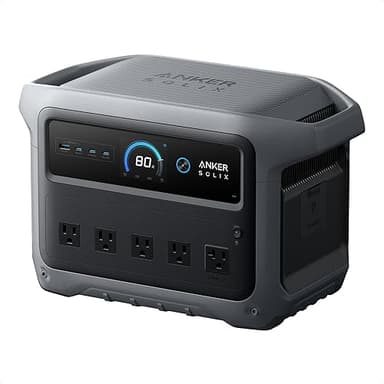
The Anker SOLIX C1000 Gen 2 (last checked $699.99 · checked Oct 19, 2026 · see on Amazon) accepts up to 600W solar input. Pair it with three 200W panels for maximum intake, or two if you're sizing for partial-sun conditions. At 500 Wh daily draw with 4 sun hours, one 200W panel covers your use but leaves no reserve — two panels (400W total input) rebuild the battery faster and handle cloudy mornings.
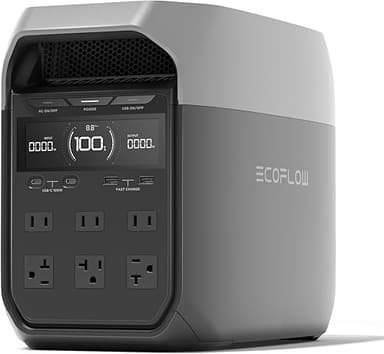
The EcoFlow Delta 3 (last checked $629.00 · checked Oct 19, 2026 · see on Amazon) maxes out at 500W solar input. Two 200W panels saturate the controller. A single 200W panel works for sub-400 Wh daily loads in good sun, but you'll wait until mid-afternoon to top off after a heavy night.
If your panels deliver more wattage than the station accepts, the excess goes nowhere. A 600W array on a 500W input station charges at 500W — the extra 100W just makes the panels run cooler. Not harmful, but you paid for capacity you can't use.
For more on why your station might charge slower than spec sheets promise, see our guide to solar generator charging delays.
Panel Comparison
| Spec | Jackery SolarSaga 100W Air | Bluetti PV200 Solar Panel | Renogy 400W Portable Solar Suitcase | Anker SOLIX PS200 Bifacial Solar Panel |
|---|---|---|---|---|
| Rated Power | 100 W | 200 W | 400 W | 200 W |
| Efficiency | 23 % | — | 23 % | — |
| Foldable | Yes | Yes | Yes | Yes |
The Renogy 400W suitcase (last checked $495.99 · checked Oct 11, 2026 · see on Amazon) delivers the output of two 200W panels in one folding unit — fewer cables, faster setup. It pairs well with stations that accept 400W or more solar input. At 23% panel efficiency, it extracts more power per square foot than budget panels.
Foldable 200W panels like the Anker SOLIX PS200 Bifacial (last checked $499.99 · checked Oct 19, 2026 · see on Amazon) and Bluetti PV200 (last checked $349.00 · checked Oct 19, 2026 · see on Amazon) balance portability and output. One panel handles 300–400 Wh daily loads in good sun; two panels cover 600–800 Wh and provide reserve capacity for bad weather. Whichever you pick, plan on folding-panel output fading over a few seasons of sun — where folding panels wear out first covers the warranty gap against rigid glass.
FAQ
Can I recharge a 1000Wh station in one day with one 200W panel?
Sometimes. At 4 peak sun hours, a 200W panel delivers roughly 520 Wh per day (200 × 0.65 × 4). That refills half the battery from empty, or tops it off if you only used 500 Wh overnight. In 6-hour summer sun, the same panel delivers 780 Wh — enough to recover from most nightly draws but not a full drain. Two 200W panels (400W total) guarantee a daily reset in all but the worst weather.
What happens on cloudy days?
Panel output drops to 10–25% of rated capacity under heavy overcast — a 200W panel might deliver 20–50W. Light clouds cut output to 40–60%. You won't fully recharge on cloudy days; you're minimizing the deficit. This is why the 0.65 multiplier and rounding up matter — they build in margin for weather variability. Oversizing by one panel turns a deficit day into break-even.
Is it better to buy one big panel or two small ones?
Two smaller panels cost more and take more space, but they handle partial shade better — if one panel is shadowed, the other keeps producing. A single large panel (or suitcase array) is cheaper per watt and faster to deploy, but shade on any part of the panel cuts total output disproportionately. If you camp in forests or near cliffs, splitting capacity across two panels reduces risk. In open desert or plains, one large panel is simpler.
Do sun hours mean daylight hours?
No. Peak sun hours measure equivalent hours at 1,000 W/m² irradiance. A location might see 14 hours of daylight in summer but only 5.5 peak sun hours — the times when the sun is high enough and direct enough to drive full panel output. Early morning and late afternoon light is weak; panels produce a fraction of rated power even though it's technically sunny. Plan around peak hours, not dawn-to-dusk.
Can I over-panel my station?
Yes, but the excess goes unused. If your station accepts 500W solar input and you connect 600W of panels, the charge controller clamps intake at 500W. The extra 100W just reduces voltage drop and keeps the panels cooler — not harmful, but you paid for capacity you can't harvest. Match total panel wattage to your station's input ceiling unless you're planning to upgrade the station later.
How do I calculate solar panel needs for winter use?
Use your location's winter peak sun hours — often 2–3 hours instead of summer's 5–6. Plug the lower number into the formula: daily Wh ÷ (rated W × 0.65 × winter hours). A 500 Wh daily load that needs one 200W panel in summer (500 ÷ 520 = 0.96) requires two panels in winter (500 ÷ 260 = 1.92). If you camp year-round, size for winter and enjoy surplus capacity in summer.
Who Should Buy What
Weekend campers pulling 300 Wh per day need one 200W panel in good sun, two 100W panels for safety margin or forest shade. Pair with a 1,000 Wh station like the Anker SOLIX C1000 Gen 2 (last checked $699.99 · checked Oct 19, 2026 · see on Amazon) for two nights off-grid before you need full sun to reset.
CPAP users at 500 Wh nightly should run two 200W panels (400W total) to guarantee a daily recharge even in variable weather. A single 200W panel works in summer high-country or desert, but you're one cloudy morning away from rationing. The EcoFlow Delta 3 (last checked $629.00 · checked Oct 19, 2026 · see on Amazon) pairs well — its 500W solar input matches a two-panel setup exactly.
Off-grid fridge setups consuming 800 Wh per day need two 200W panels minimum, three if you winter-camp or deal with frequent clouds. The Renogy 400W suitcase (last checked $495.99 · checked Oct 11, 2026 · see on Amazon) consolidates that into one deployable unit. Match it to a station with 400W+ solar input to use the full array.
Run the math with your own numbers. The formula doesn't negotiate, but it also doesn't hide anything — plug in your daily load, your local sun hours, and the panel wattage you're considering. Round up, add one panel for weather insurance, and you'll know whether "recharges from the sun" means daily independence or a slow bleed you only notice on day three.