
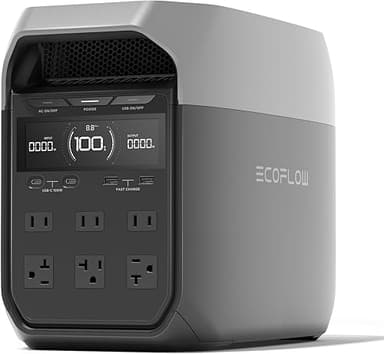
Our Review
The Delta 2's successor keeps the 1800W output and 500W solar ceiling, moves to a 4,000-cycle battery, and cuts AC recharge to 56 minutes — a faster, longer-lived 1kWh pick that trails the Anker SOLIX C1000 Gen 2 only on running output, solar input, and weight.
Specifications
| Capacity | 1024 Wh |
|---|---|
| Continuous output | 1800 W |
| Surge output | 3600 W |
| Battery chemistry | LiFePO4 |
| Cycle life (to 80%) | 4000 cycles |
| AC recharge | 56 min |
| Max solar input | 500 W |
| Weight | 27.6 lbs |
The EcoFlow Delta 3 is the model that replaced the Delta 2 on Amazon: the old Delta 2 listings now redirect to it. The headline numbers carry over — 1,024Wh, 1,800W running output, 500W solar input — and the changes are in the places that matter for long-term ownership.
The battery is rated for 4,000 cycles to 80% capacity, a third more than the Delta 2's 3,000, which puts it level with the Jackery Explorer 1000 v2 and the Anker SOLIX C1000 Gen 2. AC recharge drops to 56 minutes from a 1,500W input (the Delta 2 took 80). Surge output rises to 3,600W, twice the running rating, which gives more margin for the startup spike of a fridge compressor — see Surge Watts vs Running Watts for why that number matters. EcoFlow lists UPS switchover under 10ms, though a desktop PC may still not ride through it (see UPS transfer time: can a power station replace a UPS?).
This review is spec-based: we have not handled or tested the unit, and the figures below are manufacturer ratings from EcoFlow's US product page for the DELTA 3, checked against the Amazon listing.
Pros
- 4,000-cycle LiFePO4 battery — up from the Delta 2's 3,000
- 56-minute AC recharge from the included 1,500W input
- 1,800W output with 3,600W surge
- 500W solar input, 20% above the Jackery 1000 v2
Cons
- 27.6 lbs — about 4 lbs heavier than the Jackery Explorer 1000 v2
- 500W solar input (0.49 W/Wh) trails the Anker C1000 Gen 2's 600W
- Newer model with less field history than the Delta 2 it replaces
What it actually runs
A full 1,024Wh charge gives about 870Wh usable (rated Wh × 0.85, applied once):
| Device | Typical draw | Runtime per charge |
|---|---|---|
| CPAP (humidifier on) | 60W | ~14.5 hours (1.5 nights) |
| Full-size fridge | ~65W avg | ~13 hours |
| 65″ LED TV | 100W | ~8.5 hours |
| Laptop | 50W | ~17 hours |
| Phone top-ups | 15Wh each | ~58 charges |
How we scored it
Scored against the published rubric:
- Longevity 4.5 — 4,000 rated cycles.
- Output headroom 4.3 — 1,800W is a 4 on the absolute table and 1.76 W/Wh is a 4 on the proportionate table; surge is 2.0× running, so +0.3.
- Solar intake 3 — 500W ÷ 1,024Wh = 0.49 W/Wh.
- Recharge speed 5 — 56 minutes on the in-box 1,500W AC input (the arithmetic floor is 1,024Wh ÷ 1,500W ≈ 41 minutes; we score the stated figure's band, under 60 minutes).
- Value 5 — (1,024Wh × 4,000 cycles) ÷ 1000 ÷ $599 ≈ 6.8 kWh per dollar at the 2026-10-10 street price.
Weighted: 4.5 × 25% + 4.3 × 20% + 3 × 15% + 5 × 15% + 5 × 25% = 4.4.
Is the EcoFlow Delta 3 better than the Delta 2?
On paper, yes, on three points: a 4,000-cycle battery against 3,000, a 56-minute AC recharge against 80, and 3,600W surge against 2,700W. Capacity, running output, and solar input are unchanged. The Delta 2 is no longer sold at Amazon, so the Delta 3 is the model to buy.
Can the EcoFlow Delta 3 run a fridge?
Yes. 1,800W running and 3,600W surge start a standard fridge, and the 1,024Wh battery keeps one cold for roughly 13 hours of cycling. Check the nameplate on very high-surge compressors.
Can I add more battery to the Delta 3?
Yes. EcoFlow lists the DELTA 3 as expandable to 5kWh with its extra batteries, including the DELTA 2, DELTA 2 Max, and DELTA 3 expansion batteries. Confirm which pieces and cables you need before planning around it.
Who it's for: buyers who want 1,800W of headroom, 500W of solar input, and a 4,000-cycle battery in one 1kWh station. If lighter weight and retail-store returns matter more than output, compare it against the Jackery Explorer 1000 v2 (currently $499.00 · see on Amazon), and see our Delta 3 vs Jackery 1000 v2 comparison.