
Our Review
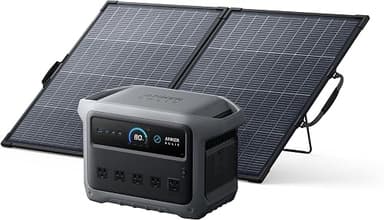
The C1000 Gen 2 we already recommend, bundled with a 200W bifacial panel for solar-ready power out of the box — 1,024Wh and 2,000W cover a fridge, CPAP, and a weekend of devices, at a real premium over the station alone.
Specifications
| Capacity | 1024 Wh |
|---|---|
| Continuous output | 2000 W |
| Surge output | 3000 W |
| Battery chemistry | LiFePO4 |
| Included panel | 200 W |
Rating corrected October 11, 2026: 4.5 → 4.6. When this review moved to the Gen 2 bundle in August, its score wasn't re-derived with the bundled-panel value adjustment our rubric applies to every bundle. The full factor math is on our ratings page.
This bundle pairs the 1,024Wh Anker SOLIX C1000 Gen 2 with a 200W bifacial panel, so you're solar-capable the moment it arrives — no separate panel purchase or compatibility guesswork. The 2,000W output (3,000W surge) handles a full-size fridge plus the usual camp devices, and LiFePO4 chemistry means a long service life (LiFePO4 vs NMC).
The 200W bifacial panel recharges the battery over a sunny day — the bifacial cells pick up some reflected light a single-sided panel can't — but pair expectations with reality on solar throughput (why solar runs below its rating). It's the natural choice if you want the proven C1000 Gen 2 platform plus a panel without assembling the pieces yourself — though that convenience carries a real premium: at our October 11, 2026 check the bundle ran $849.99 against $669.00 for the standalone C1000 Gen 2 (last checked $499.99 · checked Oct 26, 2026 · see on Amazon), about $181 for the included panel. A 200W bifacial panel sold on its own for $399.99 (PS200 Bifacial (last checked $499.99 · checked Oct 19, 2026 · see on Amazon)) on the same check, so the bundle still beat buying the station and panel separately, by about $219. Both gaps move with every price change; check today's prices before deciding.
Pros
- Solar-ready out of the box — 200W bifacial panel included
- 2,000W output (3,000W surge) runs a full-size fridge
- Proven C1000 Gen 2 platform — 4,000-cycle battery, 49-minute recharge
- Good all-around camping + backup capacity
Cons
- Single 200W panel means a full-day recharge
- About $181 more than the station alone (October 2026 check)
What it actually runs
A full 1,024Wh charge gives about 870Wh usable (1,024 × 0.85):
| Device | Typical draw | Runtime per charge |
|---|---|---|
| Full-size fridge | ~65W avg | ~13 hours |
| CPAP (humidifier on) | 60W | ~1.5 nights (8-hour nights) |
| 65″ LED TV | 100W | ~8.5 hours |
| Phone top-ups | 15Wh each | ~58 charges |
The single 200W bifacial panel harvests roughly 600–900Wh on a sunny day — close to a full refill, but expect to run the battery down faster than one panel restores it under heavy use.
How long does the included 200W panel take to recharge it?
A full sunny day. One 200W bifacial panel realistically restores 600–900Wh, so it nearly refills the 1,024Wh battery in a day of good sun — fine for steady camping, slower if you're drawing heavily.
Can it run a full-size refrigerator?
Yes — 2,000W output (3,000W surge) starts a standard fridge and keeps it cold for about 13 hours of cycling per charge.
Who it's for: buyers who want one box that does camping and outage backup with solar included. It is the bundle we rank first in the best solar generator guide, largely on that 600W input. Prefer the best app and data? Compare the EcoFlow Delta 3 (last checked $629.00 · checked Oct 19, 2026 · see on Amazon), sold without a panel.