
The box says solar generator. Inside is a 1,024Wh battery and a 200W panel. In the field the panel makes about 130W, so the battery takes eight hours of peak sun to refill from empty — and a September day in most of the country delivers four or five. The "generator" in the name is a battery you top up over two days, not a machine that makes power on demand.
Every solar generator on the market is a portable power station bundled with one or more solar panels. Nothing in the box produces anything the panel doesn't, and the panel's rating is a lab number. So the question that separates a good bundle from a bad one isn't capacity, output, or the app. It's whether the panel in the box can put back, in a real day of sun, what you took out the night before — and whether the station will accept more panel when it can't.
This guide compares the six solar generator bundles this site tracks on exactly that: usable capacity, what the included panel delivers after field derating, how many hours of peak sun a refill takes, and what the bundle costs over the station alone.
The one-line answer: the best solar generator for most people is the Anker SOLIX C1000 Solar Generator — the station this site rates highest in the 1kWh class, with a 200W bifacial panel and a 600W input that leaves room for two more — and the best solar generator for home backup is the Jackery Solar Generator 2000 v2, the only 2kWh bundle here, which ships with two panels so its refill time matches the 1kWh kits.
How We Picked
Each bundle's rating comes from the published rubric on how we research: longevity, output headroom, solar intake, recharge speed on the in-box supply, and value at street price. On top of the rubric, three bundle-specific questions decide the order below:
- Does the included panel refill the station in a real day? Panel output is rated watts × 0.65 — the planning factor this site uses everywhere for heat, angle, haze, and dirt — and the station's max solar input clips anything above it. Hours to full = rated Wh ÷ effective input.
- Is the panel one you'd buy separately? A bundle that ships a panel the station can't fully use, or one you'd replace within a season, is a discount on the wrong part.
- What does the bundle cost over the station alone? Bundle premiums move with sales; every price on this page is a live link, not a number in the text.
We did not test any of these units. Every figure reconstructs from manufacturer specifications and the derating factors above; where a review reports a range, the range is quoted.
Quick Picks: The Best Solar Generator for Each Use
The Refill Table: Hours of Peak Sun to Full
The arithmetic once, then the table. Field output = included panel watts × 0.65. Effective input = the smaller of field output and the station's max solar input. Hours to full = rated Wh ÷ effective input, from empty, before the charge controller's taper in the last 10–20%. Days assume 4.5 peak sun hours, a spring or fall day under open sky.
| Bundle | Station | Included panel | Field output (×0.65) | Max solar input | Hours of peak sun to full | Days at 4.5 sun hours |
|---|---|---|---|---|---|---|
| Anker SOLIX C1000 Solar Generator | 1,024Wh | 200W bifacial | 130W | 600W | 7.9 | 1.8 |
| Bluetti AC180 Solar Generator | 1,152Wh | 200W | 130W | 500W | 8.9 | 2.0 |
| Jackery Solar Generator 1000 v2 | 1,070Wh | 200W | 130W | 400W | 8.2 | 1.8 |
| EcoFlow Delta 2 Solar Generator | 1,024Wh | 220W bifacial | 143W | 500W | 7.2 | 1.6 |
| Jackery Solar Generator 2000 v2 | 2,042Wh | 2 × 200W | 260W | 400W | 7.9 | 1.7 |
| EcoFlow River 2 Pro Solar Generator | 768Wh | 220W | 143W | 220W | 5.4 | 1.2 |
Two things the table says that the marketing doesn't. First, every single-panel 1kWh bundle is a two-day refill from empty; the panel in the box is sized to keep pace with light daily use, not to reset the battery each afternoon. Second, the column that decides whether you can fix that is max solar input: the C1000's 600W ceiling takes three of its panels, the Delta 2 and AC180 take two, the Jackery 1000 v2 takes two, the 2000 v2 is already at its 400W ceiling with the two it ships with, and the River 2 Pro is at its ceiling with one. Run any other panel-and-station pairing through the solar recharge time calculator.
Side by Side
| Spec | EcoFlow River 2 Pro Solar Generator (220W) | EcoFlow Delta 2 Solar Generator (220W) | Jackery Solar Generator 1000 v2 (200W) | Anker SOLIX C1000 Solar Generator (200W) | Bluetti AC180 Solar Generator (200W) | Jackery Solar Generator 2000 v2 (2x200W) |
|---|---|---|---|---|---|---|
| Capacity | 768 Wh | 1024 Wh | 1070 Wh | 1024 Wh | 1152 Wh | 2042 Wh |
| Continuous Output | 800 W | 1800 W | 1500 W | 2000 W | 1800 W | 2200 W |
| Surge Output | 1600 W | 2700 W | 3000 W | 3000 W | — | — |
| Weight | — | 27 lbs | 23.8 lbs | — | — | — |
| Battery Chemistry | LiFePO4 | LiFePO4 | LiFePO4 | LiFePO4 | LiFePO4 | LiFePO4 |
| Max Solar Input | — | 500 W | 400 W | — | — | — |
| Included Panel | 220 W | 220 W | 200 W | 200 W | 200 W | 400 W |
The Six Bundles, in Rating Order
Anker SOLIX C1000 Solar Generator — Best Overall (4.6)
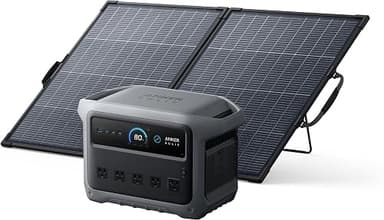
Anker · SOLIX C1000 + 200W
1024 Wh · 2000W output · 200W panel
The station inside is the Anker SOLIX C1000 Gen 2 (currently $699.99 · see on Amazon), the unit this site already recommends first in the 1kWh class: 1,024Wh of LiFePO4 rated for 4,000 cycles, 2,000W output with 3,000W surge (enough for a full-size fridge), and a 49-minute AC recharge for the days you're near a wall. The bundle adds a 200W bifacial panel, which picks up some reflected light a single-sided panel can't, and — the number that matters most here — a 600W solar input, the highest ceiling of any 1kWh bundle in the group. One panel is a two-day refill; three of them (the ceiling) cut that to about 2.6 hours of peak sun.
At the time of its review the bundle priced below the station and panel bought separately; check both live links, because the spread moves with sales. Usable capacity is about 870Wh: roughly 13 hours of fridge, or a night and a half of a humidified CPAP.
Best for: one kit that covers camping, a weekend outage, and a fridge — and the buyer who expects to add panels later. Don't buy if you will only ever run one panel and never need 2,000W; the Jackery 1000 v2 bundle delivers nearly the same nights per charge for less.
Bluetti AC180 Solar Generator (4.1)
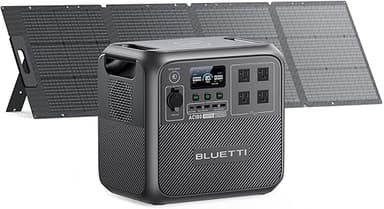
The AC180 carries 1,152Wh — a touch more than the 1kWh crowd — with 1,800W output and Bluetti's Power Lifting mode for resistive loads like kettles and heaters, plus fast AC charging when you're near power. The included 200W panel is the same two-day refill as the other single-panel kits, and the station's 500W solar ceiling takes a second panel. About 980Wh usable: 15 hours of fridge, or two humidified CPAP nights.
Best for: the fridge-and-devices camper who wants a little more headroom than 1kWh without stepping up to a 60 lb unit. Don't buy if you need the surge rating for a large compressor — the C1000's 3,000W surge is the safer margin — or you need a station weight to plan a carry — our data has none for this SKU.
Jackery Solar Generator 1000 v2 — Best Long-Term Value (4.1)
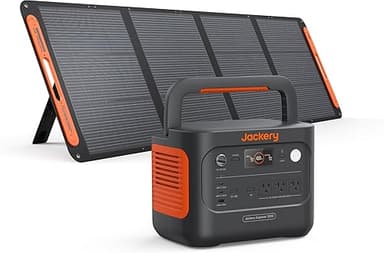
Jackery · Explorer 1000 v2 + 200W
1070 Wh · 1500W output · 200W panel · 23.8 lbs
The Explorer 1000 v2 (currently $499.00 · see on Amazon) inside is the lightest station in this group at 23.8 lbs, carries a 4,000-cycle LiFePO4 pack, and is the one you can return to a big-box store. The 200W SolarSaga panel is a two-day refill; the 400W ceiling takes exactly one more. The trade is output: 1,500W with 3,000W surge starts most fridges but with less continuous headroom than the 1,800–2,000W rivals — check yours in the appliance surge sizer. About 910Wh usable: a night and a half of humidified CPAP, 14 hours of fridge.
Best for: the buyer who values a decade of cycles and an easy warranty over peak output. Don't buy if you plan to run a microwave and a fridge at once, or want to grow past two panels.
EcoFlow Delta 2 Solar Generator (3.9)
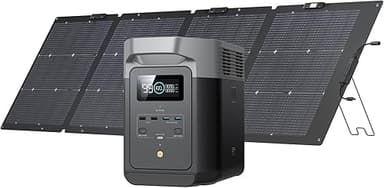
EcoFlow · DELTA 2 + 220W
1024 Wh · 1800W output · 220W panel · 27 lbs
Currently unavailable: Amazon's Delta 2 bundle listing now serves the standalone EcoFlow Delta 3, sold without a panel. The analysis below is kept for reference; its rating tracks the product, not its stock.
The Delta 2 bundle has the best-looking refill line in the 1kWh group — 7.2 hours from empty on its 220W bifacial panel — and the feature that makes solar setups easier to get right: an app that shows live solar input, so you know whether you're actually harvesting what the panel can deliver. The 500W ceiling takes a second panel. What holds it below the C1000 is the battery: 3,000 rated cycles, mid-pack for the class. About 870Wh usable.
Best for: anyone who wants to see the solar number rather than infer it, and who'll add a second panel. Don't buy if cycle life is the spec you're paying for; the Anker and Jackery packs are rated for a third more.
Jackery Solar Generator 2000 v2 — Best for Home Backup (3.7)
Jackery · Explorer 2000 v2 + 2x200W
2042 Wh · 2200W output · 400W panel
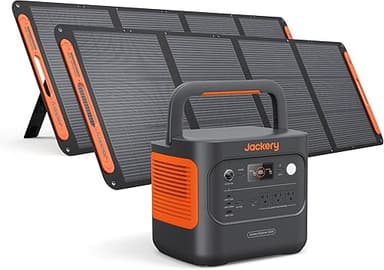
This is the bundle for people who don't want to ration: 2,042Wh, 2,200W output, a 4,000-cycle battery, and two 200W panels in the box. About 1,735Wh usable is 27 hours of fridge or 3.5 humidified CPAP nights per charge, and the two panels together refill it in 7.9 hours of peak sun — the same two-day cycle as the 1kWh kits, because the intake doubled along with the capacity. The catch is that 400W is also the station's ceiling: the 0.20W-per-Wh solar-to-capacity ratio is the lowest here, and there is no adding a third panel. It's a 61.7 lb wheeled unit and the highest-priced bundle we list.
Best for: multi-day outages and basecamp or RV use where the unit stays put. Don't buy if you want to carry it, or you expect to scale the array; the C1000 with three panels refills faster than this ever can.
EcoFlow River 2 Pro Solar Generator — Best Budget (3.4)
EcoFlow · RIVER 2 Pro + 220W
768 Wh · 800W output · 220W panel
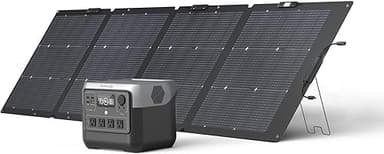
The cheapest and lightest complete solar setup here: 768Wh of LiFePO4 and a 220W panel that refills it in about 5.4 hours of peak sun — the shortest refill in the group, because the panel is large relative to the battery. The honest limit is 800W output (1,600W surge): CPAP, laptops, lights, a mini fridge, not a full-size refrigerator or a microwave. About 650Wh usable is one humidified CPAP night with margin, or two-plus with the humidifier off.
Best for: solo camping, a grab-and-go outage kit, and CPAP users who need one night and a panel to reset it. Don't buy if the load includes a compressor bigger than a camping fridge, or you need more than one night between charges — the 220W input is the ceiling, so it can't be grown.
Best Solar Generator for Home Backup
For an outage that runs past a night, two numbers set the floor: about 2kWh of capacity and at least 400W of solar intake. A full-size fridge alone uses roughly 1.5kWh a day (65W average × 24 hours), and a router, a few lights, and phone charging add a couple of hundred watt-hours more. A 1kWh bundle is a fridge until the following afternoon; a 2kWh bundle is a fridge plus the essentials through a day and change, and its panels return about 1.2kWh on a 4.5-sun-hour day — enough to stretch a second day into a third.
Of the six, only the Jackery Solar Generator 2000 v2 clears both numbers out of the box. The Anker C1000 bundle gets there a different way: add two more panels to reach its 600W ceiling, and it returns more energy per sun hour than the Jackery, from a lighter unit, on less capacity — a better fit if the outage risk is short and frequent rather than long and rare.
Two more things matter for backup that don't for camping. UPS or EPS mode: leave the station plugged into the wall with the fridge and router plugged into it, and it switches to battery when the grid fails — in 10–30ms depending on model, which the fridge and router never notice and a desktop PC might. The figures by model are in can a power station replace a UPS?. And the honest limit: none of these powers a house. A typical US home draws on the order of 30kWh a day; a 400W array returns about 1.2kWh. A solar generator keeps the fridge cold, the phones charged, the router up, and a CPAP running. Size for that, and it does it well.
Bundle or Separate?
Two rules cover most cases, and the full argument covers the rest. Buy the bundle when the included panel is one you would have chosen anyway and the kit prices below the station and panel bought separately — check both live prices, because they discount on different schedules. Buy separately when you want more panel than the box ships, or when the station's solar ceiling is high enough that a single 200W panel wastes it: the C1000's 600W input is the clearest case for buying the station and a 400W suitcase instead. One more consideration when the panel is the long-term piece: bundled folding panels are warrantied for 1–3 years of output, not the 25 of a rigid panel — why folding panels wear faster.
Frequently Asked Questions
Are solar generators worth it?
As a battery with a panel, yes, provided you size the panel to what you actually use. The bundles above return roughly 600–900Wh per sunny day on a single 200W-class panel, which covers light camping use or a CPAP night with the humidifier off. They are not worth it as a substitute for a fuel generator on a large load: a 400W array cannot keep up with a full-size fridge, a heater, and a microwave. The value is silence, no fuel, indoor use, and a battery rated for 3,000–6,000 cycles.
How long does a solar generator take to charge?
From the included panel, 5–9 hours of peak sun for the six bundles here, which is two days in spring or fall sun for every 1kWh kit and just over a day for the River 2 Pro. From the wall, 49 minutes to about two hours depending on the station. Peak sun hours are not daylight hours: a 12-hour summer day delivers 5–6.5 of them, a winter day in the north 2–3. Run your own panel and location through the solar recharge time calculator.
Can a solar generator run a refrigerator?
Five of the six can start and run a full-size fridge — every bundle here except the River 2 Pro, whose 800W output and 1,600W surge are sized for a mini fridge. A fridge draws about 65W averaged over its compressor cycle, so a 1kWh bundle runs one for roughly 13–15 hours per charge and the 2kWh Jackery for about 27. Whether it starts is a surge question, not a capacity one: check the compressor against the stations in the appliance surge sizer.
Can a solar generator power a house?
No. The largest bundle here stores about 1.7kWh usable and its panels return about 1.2kWh on a good day; a typical US home uses on the order of 30kWh a day. What a solar generator powers through an outage is the short list that matters: refrigerator, router and modem, phones, lights, a CPAP. Whole-home backup is a different product category, with a transfer switch and tens of kilowatt-hours.
What size solar generator do I need for camping?
For one or two people running lights, phones, a laptop, and possibly a CPAP, 500–800Wh with a 200W-class panel: the River 2 Pro bundle refills fastest of the six and weighs the least. Add a 12V compressor fridge or a second CPAP and the 1kWh class is the floor — the C1000, AC180, Jackery 1000 v2, or Delta 2 bundles all cover a fridge and a CPAP through the night, with a two-day refill on one panel. The sizing arithmetic is in how many solar panels do I need?.
Do solar generators work in winter?
The battery does; the panel mostly doesn't. Winter peak sun hours at northern latitudes run 2–3 a day, so a 200W panel returns 260–390Wh — a third of what it delivers in June. Cold, clear days push panel efficiency above the 0.65 planning factor, but the short sun window swamps that gain. In winter, treat the panel as a top-up and plan on the wall or the car's 12V port for real recharging, and keep the battery above freezing while charging: LiFePO4 packs limit or refuse charge below about 32°F.
The Bottom Line
Pick by the refill table, not the capacity number on the box. For most buyers that lands on the Anker SOLIX C1000 Solar Generator (currently $799.99 · see on Amazon): the best station in the class, a real panel, and the headroom to add two more. For multi-day outages, the Jackery Solar Generator 2000 v2 (currently $1399.00 · see on Amazon) is the only kit that ships with the capacity and the intake to match. For one person and one night, the EcoFlow River 2 Pro Solar Generator (currently $719.00 · see on Amazon) is the cheapest way to own the whole loop. If you'd rather start with the station and choose the panel yourself, the complete buyer's guide covers the stations on their own.