
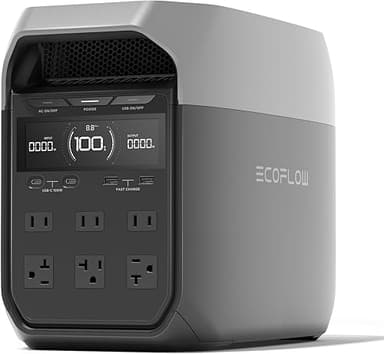
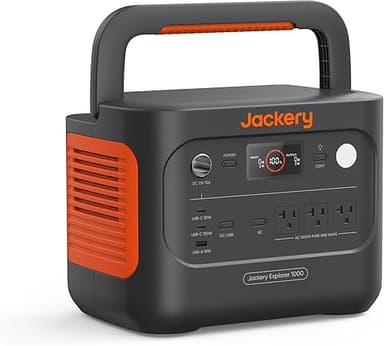
The EcoFlow Delta 3 replaced the Delta 2 on Amazon, which makes this the head-to-head most 1,000Wh shoppers now need. Its main changes are a 4,000-cycle battery and a faster wall recharge, which erase two of the Jackery's three biggest advantages over the old Delta 2. What's left comes down to three differences.
Output and headroom. The Delta 3's 1,800W running and 3,600W surge give more room than the Jackery's 1,500W running and 3,000W surge. If you will push a kettle, a microwave, or several large draws at once, the EcoFlow has the edge — see Surge Watts vs Running Watts for why peak draw matters.
Solar input. The Delta 3 accepts 500W against the Jackery's 400W, which shortens a full solar refill.
Weight and capacity. The Jackery is about 4 lbs lighter (23.8 vs 27.6 lbs) and holds 46Wh more rated capacity (1,070Wh vs 1,024Wh).
Delta 3 vs Jackery 1000 v2: the spec sheet side by side
Every figure below is the manufacturer's rating (Delta 3 figures from EcoFlow's US product page). Where a number is our arithmetic, the formula is stated underneath.
| Spec | EcoFlow Delta 3 | Jackery Explorer 1000 v2 | Edge |
|---|---|---|---|
| Rated capacity | 1,024Wh | 1,070Wh | Jackery (+46Wh) |
| Usable capacity (× 0.85) | ~870Wh | ~910Wh | Jackery |
| Running watts | 1,800W | 1,500W | Delta 3 |
| Surge watts | 3,600W | 3,000W | Delta 3 |
| Battery chemistry | LiFePO4 | LiFePO4 | Tie |
| Rated cycle life | 4,000 cycles | 4,000 cycles | Tie |
| AC recharge to full (rated) | 56 minutes | 60 minutes | Delta 3 (marginal) |
| Max solar input | 500W | 400W | Delta 3 |
| Advertised UPS switchover | Under 10ms | ~20ms | Delta 3 |
| Expandable battery | Yes (EcoFlow expansion batteries) | No | Delta 3 |
| Weight | 27.6 lbs | 23.8 lbs | Jackery |
The Delta 3 takes six of eleven rows and the Jackery three, with two ties — but weight and capacity are the Jackery's, and they are the specs you feel every time you carry it. Check the rows against your load list before you count them.
Usable Wh = rated Wh × 0.85 (inverter loss, applied once — how we calculate runtime).
What each one actually runs
Runtime = usable Wh ÷ device watts. The 0.85 factor is already in the usable figure, so device draw is used as-is.
| Load | Typical draw | EcoFlow Delta 3 (~870Wh) | Jackery 1000 v2 (~910Wh) |
|---|---|---|---|
| CPAP, humidifier on | 60W | ~14.5 hours (1.5 nights at 8 hrs) | ~15 hours (1.5 nights at 8 hrs) |
| Router + modem | 20W | ~43 hours | ~45 hours |
| Laptop | 60W | ~14.5 hours | ~15 hours |
| Full-size fridge (cycling) | varies | ~13 hours | ~14 hours |
The capacity gap is 4–5%, so neither station gets an extra night at these loads. They diverge at the top of the range: a 1,600W space heater or a 1,700W kettle runs on the Delta 3 and trips the Jackery's 1,500W limit. Run your own device through the CPAP runtime calculator, or size a motor load with the surge sizer.
Recharge: wall vs solar
On AC, the two are effectively tied: 56 minutes for the Delta 3 against 60 for the Jackery, both rated to full.
On solar, the Delta 3 accepts 500W to the Jackery's 400W. At our planning multiplier — real solar watts = rated panel watts × 0.65 — an array sized to each unit's maximum input gives:
- Delta 3: 1,024Wh ÷ (500W × 0.65) ≈ 3.2 hours of full sun
- Jackery 1000 v2: 1,070Wh ÷ (400W × 0.65) ≈ 4.1 hours of full sun
At 4–5 peak sun hours, the Delta 3 refills from a matched array with margin to spare, while the Jackery needs close to a full solar day. Model your own panels in the solar recharge calculator, and see why panels miss their rating in Why Your Solar Generator Charges Slower Than Advertised.
As a UPS for home backup
Neither station is a true UPS. EcoFlow quotes under 10ms for the Delta 3 and Jackery about 20ms for the 1000 v2. Most desktop PC power supplies bridge only 16–20ms, so a desktop may reboot on the Jackery and could survive the Delta 3 — but a quoted figure is not a guarantee, so put a true UPS in front of anything that must not blink. Routers, modems, laptops, and CPAPs generally ride through either. The full breakdown by model is in Can a Power Station Replace a UPS?.
FAQ
Which is better for a CPAP, the EcoFlow Delta 3 or the Jackery 1000 v2?
Effectively a tie. The Jackery's ~910Wh usable runs a 60W CPAP about 15 hours against the Delta 3's ~14.5 — the same 1.5 nights at 8 hours either way. The Jackery is lighter to carry; the Delta 3 has the faster switchover. See the full runtime math in our CPAP battery backup guide.
Which lasts longer, Jackery 1000 v2 or EcoFlow Delta 3?
Per charge, the Jackery by about 40Wh usable. Over its lifetime they are rated alike: 4,000 cycles to 80% capacity each, roughly 11 years at one full cycle a day.
Can either one run a refrigerator?
Yes. Both start a typical full-size fridge. The Delta 3 keeps one cold for about 13 hours of cycling and the Jackery for about 14. Check the nameplate on very high-surge compressors.
Which charges faster?
On AC they are within four minutes of each other (56 vs 60). On solar the Delta 3, at 500W max input vs 400W — roughly 3.2 vs 4.1 hours of full sun with a matched array at our 0.65 planning multiplier.
Can I add more battery capacity later?
Only on the Delta 3, which takes EcoFlow expansion batteries. The Jackery Explorer 1000 v2 is fixed at 1,070Wh. Confirm which expansion pieces and adapters you need before you plan around it.
What happened to the EcoFlow Delta 2?
It is no longer sold at Amazon; the old listings now serve the Delta 3. Our Delta 2 vs Jackery 1000 v2 comparison is kept for reference.
Who should buy which
Best for most buyers: Jackery Explorer 1000 v2 (currently $499.00 · see on Amazon). CPAP backup, a router through an outage, weekend camping. More usable capacity, less weight, and retail-store returns. Don't buy it if you need to run anything over 1,500W running, or you'll lean on solar for multi-day trips.
Best for high-wattage gear and solar: EcoFlow Delta 3 (currently $629.00 · see on Amazon). The extra 300W of running output, 3,600W surge, 500W of solar input, and the expansion path make it the station you grow into. Don't buy it if weight matters most.
Weighing a third option? The Anker SOLIX C1000 Gen 2 vs Jackery 1000 v2 comparison covers it, and the Delta 3 review has the rating math.